Radio & Podcast Interview about Investment Skipping Development
Last month I wrote an article about what I call “Straight-to-Execution Culture.” It’s what we’re seeing in multiple industries where investment has moved to after we’ve done all the work. It used to be you’d get investment to develop a work. Investment.
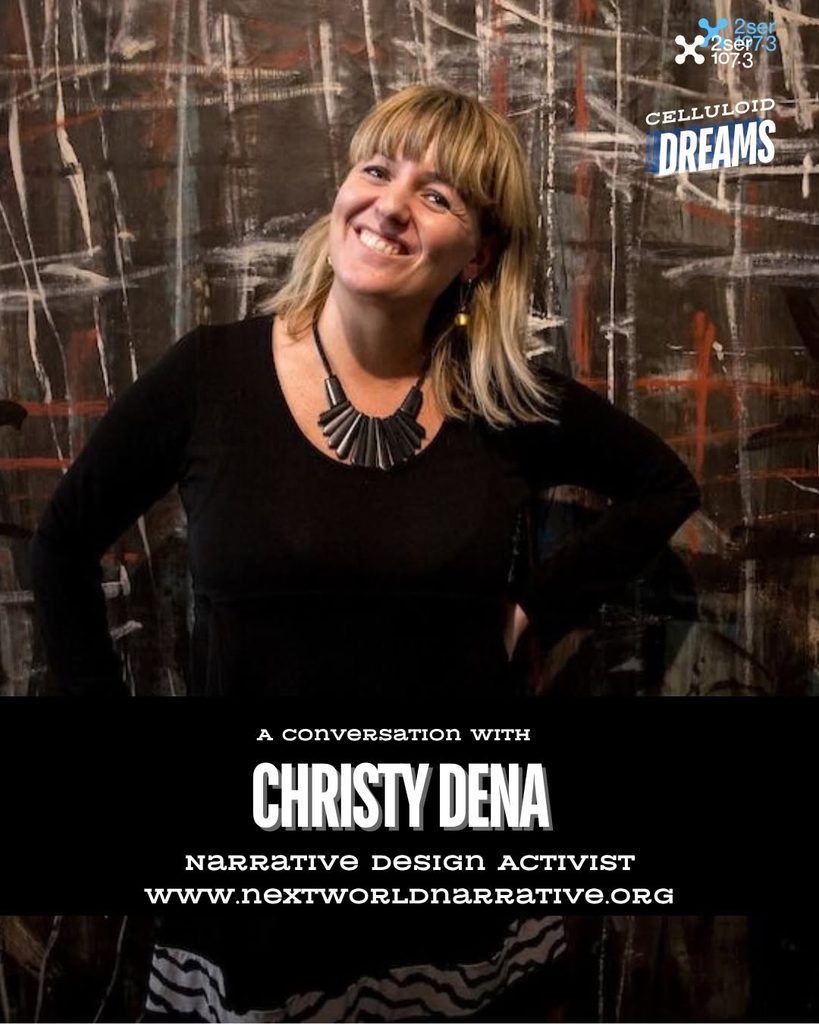
Evan Shapiro asked to interview me about it for his radio show and podcast, Celluloid Dreams (thank you Daz for the recommendation!). I had a great chat with Evan, talking about all things creative.
Special Guest: Christy Dena Evan sits down with narrative activist and all-round creative Christy Dena to talk about their new article for Next World Narrative, How do I Flourish Despite “Straight-to-Execution” Culture. What happens to creativity when every idea is expected to prove itself immediately? And how do we create space for ideas to develop, take risks and become something we couldn’t have predicted at the start?
Radio Show: https://www.2ser.com/programs/celluloid-dreams
Podcast: https://cms.megaphone.fm/channel/celluloiddreams (scroll down to interview 5)
Library Updates: We-narratives, Caring Men In Media Test, & Wholesome Fascists
Here are the latest additions to our Liberatory Craft Library! Craft tools, inspiration, & insights for building our next world, now. Some just remembered, some newly discovered.
📜 Articles
👉 Doc Burford’s ‘“lore” is a trap and will kill your story if you let it. So what can we do about it?‘
“Lore is appealing because it is the easiest thing there is to do in any kind of storytelling process. You think “why is this place like this?” “how did we get here?” “what do people call bread?” and so on, and it’s all very easy to come up with cool and interesting deviations from reality as we know it. But lore isn’t a story. It’s barely even storytelling.”
👉 Doc Burford’s ‘I was a teenage exocolonist (and so can you)’
“So you might have written a piece of comfy, cozy, escapist fiction, and you’re hoping it’ll convince people to be better people, but their reasoning for consuming your fiction was to avoid being confronted, which means that if your fiction confronts them in some way, they might get hostile, because they aren’t here for a lesson about acceptance and caring; they’re here to be pampered.”
👉 Equimundo with the Geena Davis Institute and Stephanie Tholand, ‘Caring Men in Media Test’
“It can be applied to any media with a male character carrying a sufficient arc: film, TV, radio, books, comics, video games, and more. A piece of media passes if a named male character talks to another named male character about his inner emotional life, and that disclosure is met with compassion.”
📺 Audio Visual
👉 Lucas Alpay on ‘“Show, Don’t Tell” Was Never Meant for Novelists’
“If you are drafting a novel and want to learn granular writing craft, this video breaks down the exact moments when telling flat-out beats showing.”
👉 Matt Golding interviewed by Rachel Donald on ‘The power of stories’ (thanks Andrew M!)
“The foundations of our cultural narrative and the foundations of our story archetypes in our culture do not really aid you in telling positive stories of collectively how we can change the world. So, what I’m doing at the moment is running this project called Antidote, which aims to reshape the way we tell collective action stories to help ordinary people believe that together we can change the world.”
👉 Tali Faulkner, interviewed by Patrick Klepeck on ‘Penguin Colony and the Real-Life Politics of Adapting Lovecraft’
“In the just general games landscape you know the amount of games that are made with like overt um sort of right-wing narratives…”
📖 Books
👉 Erin James & Eric Morel’s Environment and Narrative: New Directions in Econarratology (Open access)
“Two simple premises lie at the heart of this edited collection of original essays: first, that stories about the environment significantly influence experiences of that environment, and vice versa, and second that scholars can do a much better job of understanding those stories and suggesting alternatives.”
👉 Kate McCullough’s Never on Time, Always in Time: Narrative Form and the Queer Sensorium (Open access)
“In this book, I explore how writers summon queer bodily experiences by way of the senses: these experiences have
much to tell us about the pasts, presents, and futures of queer life. I am interested in how narrative form and techniques represent queer senses in order to open a more expansive temporality for writers and readers.”
👉 Natalya Bekhta’s We-Narratives: Collective Storytelling in Contemporary Fiction (Open access)
“Plural narration, performed by a group itself, gives rise to a new narrative situation: we-narrative. By tracing we-narrative’s distinctive elements and effects, I propose to make available a mode of narratological analysis that illuminates the existence in narrative fiction of this structurally and compositionally plural, collective way of telling.”
👉 Wayne C. Booth’s The Rhetoric of Fiction (2nd Edition)
“In short, the author’s judgment is always present, always evident to anyone who knows how to look for it. Whether its particular forms are harmful or serviceable is always a complex question, a question that cannot be settled by any easy reference to abstract rules. As we begin now to deal with this question, we must never forget that though the author can to some extent choose his disguises, he can never choose to disappear.”
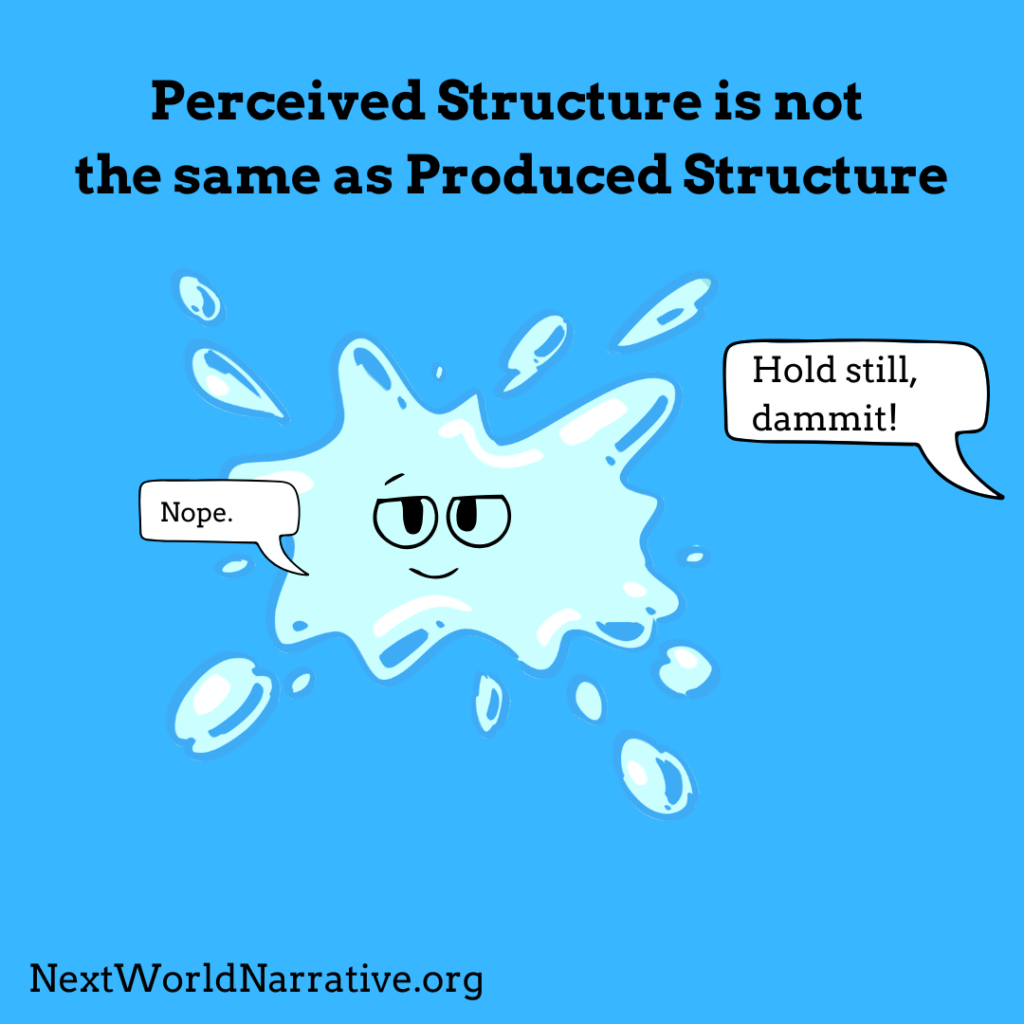
The Difference Between Perceived and Produced Structure
A liberated designer knows that we flourish when we nurture our unique ways of creating. Currently, the loudest voices in design are the ones who don’t themselves make. But a liberated designer doesn’t give anyone else authority over their creativity.
Today’s chat is about the overrepresentation of reader voices, how it skews people’s understanding of development, and what development is actually like.
I’m not talking about fans, necessarily. Yes, I’m talking about people who experience a creative work. Mostly, though, I’m talking about people who assess creative works, formally or informally. It’s their voices that currently have an inappropriate amount of influence over creatives.
Most of the loudest voices in development are not responsible for the writing, design, the crafting of the project. They’re assessors, producers, marketers, business advisors, and even lawyers. Their voices are important. But their influence is outsized because most of them don’t know (or care enough to learn) the difference between how a project appears to have been made and how it is actually made. Let alone how to faciliate mutual flourishing.
Indeed, the majority of popular screenwriting books are written by people who maybe have made one or two films or TV series. But, they’re mostly misleading, unfortunately, as Chris Neilan will expose in an upcoming article. Yes, some have had roles assessing screenplays as a ‘reader’ for a studio, but all refer to the end product as their evidence for action.
But a final script and released film, TV show, game, or novel is not the same as knowing how it is made.
To be clear, I’m not trying to gatekeep here. It’s important to me that people who are deliberately marginalised out of “industry” are heard. So, to me, credits are not a requirement for being listened to. People speak from different positions. I’m talking about how the process of making as been skewed to fit decisions people come to based on the result of making.
Screenwriter (films) John August talks about this in the podcast, Don’t Be Alone with Jay Kogen. John says that (manuals like those written by McKee and Field) ‘in general, they’re not written by people who actually did the job. They’re written by people who like observed a bunch of movies.’ In reference to their co-written book, Scriptnotes, screenwriter (films, TV) Craig Mazin adds that ‘we we try as best we can to talk about what we do, which is to start with nothing. And get to something. And the people that don’t write for a living and then write books about screenwriting just dissect things that already exist. That’s doesn’t help you when you have nothing.’
Think about the Hero’s Journey, specifically Joseph Campbell’s monomyth. The folktales from different countries, cultures, and centuries (that Joseph Campbell analysed) were not conceived using his chapter-by-chapter run-down on the stages of a hero, or Vogler’s handy infographic. I have no idea how they were developed because neither Campbell or Vogler talk about the creative processes that resulted in the journey they perceive. Now, if you believe Campell’s interpretation, and think that it’s a model that is within us all, or available to us through higher means, then why not talk about how we access that? Isn’t the point to find our own connection, not just copy? Julia Cameron made it about connection. She shifted attention away from the journey depicted on the page or screen to the Artist’s Way.
I’m talking about this because the overrepresentation of end-product voices has skewed people’s understanding of the creative process. Narrative designers try to shoehorn (is that term too old now? Is it illegal in games?) their emerging project into the end design. They feel shame and self-loathing for not being able to fit the prized mold. I know I did. Testers and assessors also get disappointed with the contrast between your work-in-progress and a familiar end product. Testers often think that the end-product is the only signal of skill. Creatives end up learning skills that lead them away from their flourishing. They end up inverting insights.
“Structure is the Symptom”
At the keynote I gave at the Joint Screenwriting Research Network and Sightlines Festival last year (2025), I mentioned the difference between how people think I’ve designed my games and how I actually have. For instance, I had a colleague respond to my Elder Spider character, saying that I was using a “mentor” character, and another colleague citing an “impact” character (ala Dramatica). Since I am versed in both, it is possible they were a subconscious influence. The process of creating was very different, though.
I didn’t start with an archetype. Instead, I started with what I wanted the players to experience: what it’s like to have someone support you because I haven’t had enough of that and it’s amazing when it happens. I also had a lovely brain trust advisor who had shared stories of elder activists. I wanted to value age in part because I’m getting older, I miss my mum who has passed, and I think we need all generations involved in taking action. I ended up doing what many pre-built structures would approve of. But I didn’t start with that or try to do that. Those archetypes don’t capture the wonderful mix of experiences and ideas specific to my journey. Those archetypes didn’t guide me to design the way I did.
Author and critic Samuel R. Delany talks about this disconnect, too. In his essay, ‘Thickening the Plot,’ in Pocket Workshop, Samuel says that discussions of plot often refer ‘to an effect a story produces in the reading’ (original emphasis). But, he says, ‘discussion of effects is only of limited use in a discussion of causes.’ To explain the difference, he talks through the process of writing. Samuel explains ‘that the writing down of words about my imagined vision (or at least the choosing/arranging of words to write down) causes the vision itself to change’ (original emphasis). That’s right. Our idea of the story, game, film, TV show, novel, changes as we create.
He says, the act of writing helps the idea become ‘clearer.’ (In my previous article we spoke about the different functions of externalising.) He adds that ‘the notating process tends to propel that action forward (or sometimes backward) in time.’ Samuel gives an example of how this works. He starts with a vague character George entering a vague room to find a vague Janice. That is his beginning point.
His writing and internal process proceeds: ‘Picture George outside the door. Look at his face; no, look closer. He seems worried…? Concerned…? No. Look even closer and write down just what you see: The lines across his forehead deepened. Which immediately starts him moving. What does he do? … He reached for the …doorknob? No. Be more specific…brass doorknob. It turned…easily? No, the word “brass”…’ [And so on.]
Over two pages, Samuel shares his internal writing process from that vague beginning point. The end result is a couple of paragraphs: ‘The lines across his forehead deepened. He reached for the brass doorknob.[…] Janice sat on the bare mattress […]‘ [And so on.]
Samuel then explains that if a reader is asked to explain the ‘plot,’ they might say, “Well this man comes looking for this woman named Janice in her room; he finds the door open and goes in only she doesn’t talk at first.” Samuel explains that while it is ‘a fair description of the reading experience,’ it’s not ‘what we started with, to write.’ He says what we do is the ‘story process’ and what they describe is ‘plot.’
Game director David Gallaher makes a similar point. He says, “A story does not begin as a clean diagram. It begins as a mess. It begins as fragments, instincts, images, lines of dialogue, half-formed characters, and ideas that contradict each other. It feels less like architecture and more like dumping every toy out of the toy box onto the floor and trying to figure out what belongs together. There is energy in that mess. There is possibility. There is play. [NP] That part is where the story is alive.” (original emphasis)
In a Scriptnotes podcast episode, Craig Mazin also explains the difference between structure perceived by the audience and the one we write. ‘Yes,’ Craig says, ‘screenplay is structure, but structure isn’t what you think it is.’ He says, ‘If you follow strict structural guidelines in all likelihood you will write a very well structured bad script.’ Like Delany’s distinction between cause and effect, Craig says, ‘Structure isn’t the dog. It’s the tail. Structure is a symptom.’ Structure is the result of the work you’ve done, not the cause.
This shift in thinking has implications. It means you can begin with any structure in the world that exists, any structures you mix together, any you generate, and even with no structure at all. Why? Because a structure will happen anyway. Because whatever you do, it will change. It needs to change, and the process needs you.
Unsatisfying Wins
I’ve been down the path of sticking to perceived structures. Just about every narrative designer has. They’re at-hand and (falsely) promise a connection with the masses. I thought, if I secretly mix in myself with their stuff, then I could get away with it. I could pass in the world of straight structure. I did. I’ve won awards for this work. Australian Writers’ Guild and WA Premier’s Book Prize awards for my interactive writing. But it didn’t resonate with audiences as much as it could, or feel as glorious as development does for me now.
Author and educator Felicia Roze Chavez talks about this in her book, The Anti-Racist Writing Workshop. Felicia says, ‘To be fair, I’ve seen the imitation exercise (imitate the “masters”) work again and again, regardless of age or ability.’ She talks about ‘sitting paralyzed before the page thinking, “This poem is neat and I am messy.”‘ She did it, though. She fit her work into the model. ‘But the win,’ she continues, ‘is empty.’ She was ‘never proud of this writing.’ ‘Where is joy? Where is play? Where is accident? Where is failure? Where is risk and discovery?,’ she asks.
My hypothesis is that it isn’t the nature of orthodox structures we use that are the defining factor. It’s that, among other things, their implied use prematurely close down the creation process. Aligning with an existing structure, or mechanics, or whatever it is, gives us the impression that it is complete. All we need to do is fasten those studs, click, click, click, and it will work. When they’re aligned it will appear finished. But the world only we can create hasn’t had a chance to unfurl. It was years later that I would get to know what it feels like for all the elements of all the ingredients I gathered showed their petals.
The Different Skills of Perceived and Produced Structural Design
I call the two different approaches perceived and produced design. [Edit: Argh, ‘produced’ may be a poor word choice considering the prevalence of producers using perceived design. Tell me your thoughts!] Both can be used. But given the prevalence of perceived structure, we need to give voice to the latter. We need to stop conflating them. Stop upholding the idea the outsider is the only position and the only insight of value. We need to also know the value of subjectivity, context, first-hand, and lived experience. We need to stop pretending that perceived design is the same as produced design. Equality is oppressive when differences are denied. Equality is liberating when all belong.
| Perceived Structural Design | Produced Structural Design |
| Projected The reader’s experience of a structure defines what it is. Example Skill: Identify character archetypes Example Skill: Identify existing “master” structures Example Skill: Identify sequence lengths | Subjective Structure is the result of hundreds of micro decisions informed by the creatives’ experiences, associations, views, and needs. Example Skill: Generate ideas by drawing on your pain and what you love Example Skill: Troubleshoot repair of an unforeseen design issue |
| Prescribed Structure is determined by others. Example Skill: Understand and apply existing structure(s) Example Skill: Design pacing of structural stages according to common sequence lengths | Chosen You can select your structure from a wide range of dramatic and real life options, or not use one at all. Example Skill: Map genre and structure Example Skill: Map meaning and structure |
| Pre-Made You don’t make a structure, you use an existing stencil. Example Skill: Apply existing structure | Customised or Generated Structure is malleable and can be designed Example Skill: Adapt existing structures according to your values and experiences Example Skill: Generate a structure based on your body’s rhythms and quirks |
| Persistent The end structure is the same as the beginning structure. It stays the same throughout the entire development process. Example Skill: Fit your ideas to an existing structure Example Skill: Continually audit and conform your work to the structure | Polymorphic Structure changes during development. Example Skill: Experiment with a starter structure Example Skill: Develop methods in mixing structures Example Skill: Design according to local (character, scene, player) needs and notice what emerges |
| All-Purpose Everyone uses the same structure because differences between people and projects are negligible. Example Skill: Removal of all personal elements that conflict with orthodox design | Protean Structures differ according to the people making and experiencing the work. Example Skill: Make any existing structure recognisably your own |
During the Q&A at the screenwriting conference last year, I laughed when I mentioned a benefit of perceived structure. Sometimes people project a traditional structure onto our wild work. Those who try to uphold design orthodoxy can inadvertedly approve of our liberated designs. Heh. Some can’t imagine a world beyond and project theirs everywhere. We’ll make our worlds anyway. We don’t need them to know it exists for us to make it. A liberated designer knows their worlds are real, too.
How to cite this page:
Dena, Christy (2026) “The Difference Between Perceived and Produced Structure” Next World Narrative, 17 September. Last updated 21 September, 2026. https://www.lovingchangestorytelling.org/articles/produced-design-is-a-bud-unfurled/
Library Updates: Originality, Anti-Racist Theatre & Underlying Models
Here are the latest additions to our Liberatory Craft Library! Craft tools, inspiration, & insights for building our next world, now. Some just remembered, some newly discovered.
📖 Books
👉 David Waddington’s The Hidden Curriculum of Videogames
https://www.mqup.ca/Books/T/The-Hidden-Curriculum-of-Video-Games
“Rather than asking whether games produce violent individuals, we might more productively ask how they contribute to a commitment to radical capitalism and a belief in highly individualistic worldviews.”
👉 Fawzi Mesmar’s Demystifying Game Development: On originality in game development
“It introduces the concept of creative sobriety—a practice that advocates better understanding our own sources of inspiration so that we can intellectually drive our creative voice closer to originality.”
👉 Mary Flanagan & Mikael Jakobsson’s Playing Oppression (and open access)
“A striking analysis of popular board games’ roots in imperialist reasoning—and why the future of play depends on reckoning with it.”
👉 Nicole M. Brewer’s The Anti-Racist Theatre: Crafting Theatrical Collaboration
“A how-to guide for theatermakers who want freedom from white supremacy in their creative practices.”
👉 Pamela Jaye Smith’s Beyond the Hero’s Journey: Other powerful mythic themes (2nd Edition)
“Having trouble making your story fit the pattern of The Hero’s Journey? Can’t quite make those paradigms match your own characters and plot? Maybe that’s because your story is actually based on a different pattern.”
📜 Articles
👉 Indi Young’s ‘What’s Wrong with Average‘
“Average solutions aren’t just average as in “meh.” They often cause harm to the people who weren’t considered in the design.”
👉 Sarah Fawn Montgomery’s ‘(Dis)Ableing the Creative Writing Workshop‘
“Though many writers experience the workshop’s desire for context, disabled writers have the added task of rewriting the very world their readers inhabit.”
👉 Shea Rigney & Tamika Worrell’s ‘A Missing Player: The absence of Indigenous games in schools‘
“Understanding how, and if, Indigenous developed video games are used in classrooms can aid in the identification of support for teachers and the benefits for students, particularly regarding colonial and decolonial discourse.”
📺 Audio Visual
👉 Eric Rosenfield/Literate Machine’s ‘How Will Capitalism End? The Orville, Eduard Bernstein, and What is to Be Done?‘
“What does comedic science fiction television show The Orville tell us about how capitalism will end?”
👉 Meguey Baker and Vincent Baker’s ‘Underlying Models‘
“Every game is based on some underlying models of our social reality. In this panel, we will discuss how to think about these models and how they will affect the games you create, with Apocalypse World as a working example.”
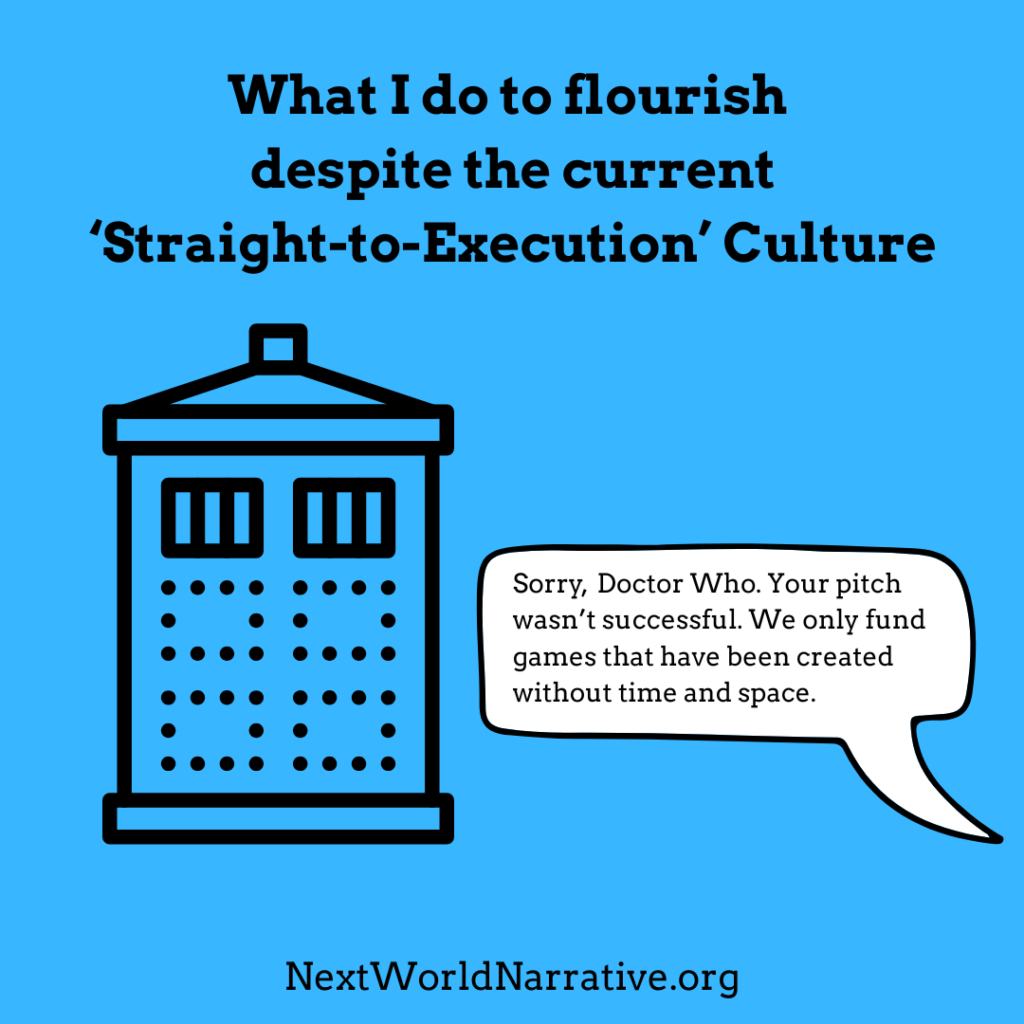
What I Do To Flourish Despite The Current “Straight-to-Execution” Culture
I love creating. I love it when people experience what I create. I love what they create. When folks around us have forgotten that they love of creation, too, it’s important we keep doing it.
If you’re involved in pitching games, films, TV shows or even books, to publishers, studios, investors, broadcasters, and some funding bodies, then you’ll know how shitty it is right now. It’s been shitty for as long as design orthodoxy kicked in, but it’s pretty bad at the moment. The shitty topic for today is the straight-to-execution culture we currently find ourselves in. It’s when publishers and studios expect a script or book to be completely figured out so your pitch doesn’t change throughout production. It’s when funding bodies expect you to have the project fully figured out before you apply, or corrall you towards polish and financial partners quickly, or consider it too high risk if it isn’t already polished. It’s when publishers expect us to have a (digital) game fully produced, with polished visuals and interactions, and an inbuilt audience as well, before they’ll even consider partnering. Which makes their role kinda redundant and offloads the creative journey entirely. What this expectation results in is a) preference for folks who have no problem publishing first thoughts; and b) a lot of folks going straight to the final look. They invest all their time and resources on art, technical FX, big name casting, and building impressions, likes, and wishlists, and not making a game that works and resonants.
It’s Everywhere
Jane Korneyko of Sova explains the situation in the (tech) startup space: “This is the reality Australian founders are walking into. Not a market that rewards potential, but one that demands demonstrated operational maturity from day one. Investors are no longer funding stories. They are funding execution.”
Similarly, in film and TV, there is an expectation to stay with what you pitch. No development of ideas. You need to have already figured it all out and you’re not allowed to change it. TV writer-producer David E Kelley (LA Law, The Practice, Anatomy of a Scandal, Lincoln Lawyer, Goliath, Ally McBeal, etc) and Craig Mazin (Chernobyl, The Last of Us, Sheep Detective, etc) spoke about this:
“With The Practice, with Ally McBeal, with Boston Public, there was no script, no outline, and no real formal pitch. With Boston Public, I sat down with Sandy Grushow, who was running Fox at the time, and said, this is going to be a high school show. It’s going to be a public high school, but it’s going to be about the faculty. It’s going to explore the lives of the faculty and the adversities they face in trying to do their jobs every day.
We talked about the tone. It’ll be both dramatic and comedic. We talked about the kids will be instruments to explore these faculty members as well as the parents. There was an understanding that would be the DNA of the show, but we would then find the show in the writing. Today, it’s very different. When you’re going to pitch a show-
Craig: They want it all.
John: -the buyers are looking for such a specificity, and there’s a danger to that because you’re not letting the writers find and feel their way. If they’re living up to the notes or the outline that was a product of that goal of specificity, it can have a very creatively constraining effect.” — Scriptnotes
You’ll have your own examples of how this applies in your area (tell me about them!).
Why is this happening?
Part of the reason for this happening is, as Jason Della Roca explains, investors stopped trusting their instincts.
Before the pandemic, Della Rocca says, a studio could raise money on a strong prototype and a credible team, on how good an early build felt in the hands. What broke that was not a crash but a glut. The surge in players through lockdown pulled in a wave of investment, and when it receded it left an oversupply of games, and of the studios making them, all pitching at once. The people with money were suddenly seeing far more of everything and could still act on only the same few.
[…] Somewhere in that glut the people writing the cheques stopped trusting their own judgement. Too many bets had missed, playtime had softened after the lockdown highs, and in his words they “lost their confidence in their ability to pick winners.” A funder who no longer trusts it has an obvious way out, which is to let the market do the judging. […] So the burden of proof moved onto the developer. Studios began doing the work a publisher was once meant to do, announcing early, cutting trailers, gathering wishlists, working festivals, viral TikTok posts and Discord, building the evidence of demand before approaching the people with money. Della Rocca calls it “inception publishing,” the point at which a developer has to run the marketing to prove the game is worth marketing. — The Side Quest
That’s not all, though. As deliberate designers, we look to multiple contexts. Not just the first one.
Another reason is that, currently, most of the loudest people advising creatives, and those in decision-making positions, are not (design) creatives themselves. We have assessors, managers, producers, and even lawyers telling creatives how to design. Now, I want everyone to have a voice. What I don’t want is those who don’t make to have the power to dictate how we make. Indeed, no one should have power over how we make. We have the best knowledge of what we need. Advice is great, but every person ultimately needs to direct their creative process. Those who are more familiar with the result of a creative process don’t know how that output came to be. (I have an article about the difference between perceived and produced structure.) Therefore, they want something they recognise (an end-product) rather than something they don’t recognise (a work-in-progress).
Part of the reason, too, is the language used to talk about craft. I went over these issues in my workshops recently (and will share in a forthcoming book). There is a deep narrative that ‘thingifies‘ life and creativity. The cumulative effect of all those folks saying that design is a “rule,” “commandment,” a “natural law,” “it was already figured out yonks ago,” and “every single story does the same thing,” etc — renders design outside our hands. Design isn’t something you figure out, you make, it’s something you “discover.” That means all you have to do is read that book, listen to that guru, copy that “master” and apply it. Bing, bang, done. Design is a thing, not a process or a relationship. This is why many decision-makers and creatives don’t know how to assess quality. They don’t know how to assess process and effect.
Part of the reason, too, is that there are plenty of folks who aren’t in games, film, or TV for the joy of making. A great number of game companies in Australia have become service studios (bought up by Keywords). They don’t do original productions, only provide art, programming, design, etc for companies. There can be a beauty in that, but I see so many uninspired by the experience. I also speak with disenfranchised colleagues who work on big name projects. They talk about meetings where it’s all about making the products gorgeous-looking and juicy, and none of the leads give a shit about design. They get paid, praised, and even awards, anyway. So, why bother?
They’ve been taught through a million paper cuts that there is only one criteria: money. It’s a red herring, though. Are developers in big money studios always the best at what they do? No. Are projects that sell a lot always good design? No. Do projects with good design always sell? No. Are projects that sell always good for the world? No.
We can say the problem is “Capitalism.” That is one term. Another I like to use is what political philosopher Sheldon Wolin calls “inverted totalitarianism.” It’s capitalist, yes. It’s anti-working-class, yes. It’s individualist, yes. It’s not top-down, though. It’s upstream. What I, and Wolin, mean is that it isn’t overtly forced but it is taken on and upheld. Wolin explains that “inverted totalitarianism comes into being, not by design, but by inattention to the consequences of actions or especially of inactions. Or, more precisely, inattention to their cumulative consequences.” In this context, design is just a thing we do to make money for ourselves, that’s it. It doesn’t contribute to culture. It’s not a process we need to spend time on. In fact, we can outsource it. We can offload it. Bada bing, bada boom. (The use of GenAI to replace creative process is not a coincidence in this culture — more about this in another post.)
But design does have consequences. For instance, if we put effort into providing more basic universal services, then people who don’t give a shit about creative works wouldn’t bother with creative works. If their basic needs were taken care of, we’d see a lot of people who aren’t here for this kind of creativity, leave. That would be great. I hope they find what enlivens them.
This non-creative-driven, design-is-a-thing, inability-to-assess-quality, and disenchantment is not a great design culture. It corrupts the creative process.
It Corrupts the Creative Process
Devs don’t have much to fund their projects. Publishers and partners want a polished product before they’ll consider funds. This leads many devs to (understandably) skip the messy-looking stage. The problem is, when we go straight to producing beautiful visuals, polished interactions, it looks like the game is ready when it isn’t. The pretty conceals the problems we haven’t solved.
“Because high-fidelity visuals don’t actually create clarity. Rather, they hide the fact that the work wasn’t done, with detail that is every bit as fake as the sketch — but enough to satisfy stakeholders who are looking for an output.” — Pavel Simonson
Ironically, pre-defining the end result makes it less likely we’ll achieve it. The creative process involves lots of dead ends and experiments that are unlikely to work. It even means going in the opposite direction at times. All of this work accumulates like an upswell and lifts us to our destination. (See research into the myth of the objective.)
Professionals behave very differently than those unfamiliar with the creative process would expect. Professional skill doesn’t mean going straight to the end product. Nope. It means going straight to multiple possible products.
“The first time most people work with a pro designer, it’s a surprise how much time they spend exploring different possible ideas. It’s not uncommon for a designer who’s working on a watch, or a mobile app, or a toaster oven, to make dozens of sketches and prototypes, maybe even hundreds as they refine the details of how everything looks and works. Many people think, “well, if you’re good at design, you should just be able to design me something good the first time.” But to design something even as seemingly simple as a backpack, designers may spend hours exploring options and asking questions.”
“Not only is picking the first option you come up with not how good design works, it’s not how good decision-making works, either. Would you marry the first cute person you met? Or move to the first country you see in a movie? An analogy offered to me by designer Delaney Cunningham is to think about the last time you bought a new pair of shoes to match a specific outfit. Did you just walk into the store and grab the first pair you saw, without looking at the size, then buy them without even trying them on? Most people know that in order to find the right pair, they have to try many different designs, make observations and then refine their idea of what good is as they go. We also know that there is a tradeoff with shoes between the price, the style and the level of comfort they offer, and every pair is somewhere different in the combination of those three qualities. Buying shoes has a sequence of steps (ha ha) that you must go through to arrive at a good solution. Design works in much the same way. It’s a process for finding and evaluating ideas to get good results.” — Scott Berkun, How Design Makes the World
We miss getting past first thoughts, which are rarely the best. We don’t get to the essential insights that having the time to reflect on what we create affords. In their paper, Alan Dix and Layda Gongora talk about the various functions of “externalising” (how we as creatives put what we have in our head into the world). They explain that we can externalise to pass on already formed ideas (informational). I want this character to say this and then this character to say that. Done. This is what many non-creatives think execution is about. Just make it! But there is also how the process of getting it out of our head helps us understand it (formational). The need to form it helps form the idea. Ah, I see I need a transition between this scene and the last. Then there is using the materials to think about the creation (transformational). I can only use three colours here. Hmm, what colour represents that character? Then there is when the materials become the subject of our thoughts (transcendental). Oh, when players see that character they interpret it in a different way, and that means they do this. Do I want my story to be about that? You see, when we can’t iterate as much as we need to, then we end up just publishing our first thoughts.
We end up putting all our energy into design-for-appeal and not design-for-resonance. This is why there are marketing pushes for first weekend and first week sales. Because once they play or watch it, it won’t reach any further. We can possibly get folks in the door, but then they’ll leave pretty quickly, won’t come back, won’t recommend it to others, and so on.
I could go on. Share stuff you see, too. Either way, we’re in a culture where so many of the folks in decision-making positions want us to go straight to the end product without development.
What to do?
For me, I love creating innovative entertainment projects with an eye for positive social impact. I don’t try to be innovative. I just create in a way that makes sense to me. Which happens to be different. I don’t try to change people, either. I do know design is contextual, though, and I want to bring out folks’ best selves. This kind of design takes longer than, “I’ll use existing mechanics and common anti-social themes.” So, here are some of the ways I amplify insights without a proper development budget. Here are ways I do what I love and get to the end many want, despite their best efforts to stop me.
- Cave & commons
- I get the most out of ideation by leaning into our different ways of seeing the world. We ideate separately and then blend together. It’s the quickest way to get a wide range of really interesting ideas you can then have fun trying to merge. It stops the same people’s ideas dominating, and ensures everyone doesn’t go with the first thoughts shared.
- Regular playtesting
- Putting my work in front of people at all draft stages accelerates my insights. I draw on our shared cognitive worlds to create a new one. I’m testing all the time with my pitches to colleagues while chatting, as well as organised tests. For me, I find it super helpful to understand how players are experiencing the work, and they come up with unintended play I often want to include.
- Deliberate questions
- Design orthodoxy encourages a fix-it culture with no regard for different creations. Feedback often assumes there is something wrong if it’s not finished yet and any difference is to be stamped out. I’ve learnt to be really strategic with my questioning to get past biases and bring back the joy of creating together. (More about this soon, too.)
- Low-fi prototyping
- Digital design is expensive. I’m working on tabletop games as well as digital games and the contrast is astounding. In the tablestop scene, you can pitch a game without art. Why? The publishers know that the game needs to work and art is something they know how to do. I wish digital publishing worked this way. If our games were assessed on the experience they facilitated with players rather than the polish, we’d see so much more wonderful stuff released. Anyway. With this insight, I use low-fi prototypes with my digital games to front-load insights as much as possible. With the 3D multiplayer game I’m currently developing, I’ve used a slide-show prototype, a live RPG, a 2D digital version using stock images, and a boardgame version to test the whole system cheaply. I can actually change something that I don’t like and the design gets better! (I also will release both the digital and tabletop versions.)
- Polymorphic development
- Related to this, I deliberately create the same project in different artforms and platforms. This reveals gaps and provides new perspectives so quickly. For instance, for a previous card game, I created a chatbot version (pre-GenAI), Twine version, and live performance versions. These were all forms I could easily do myself. So, whatever artform you can easily do. Painting? Use that.
- Full-team exposure
- Get the whole team exposed to the playtests. I learnt this from Jarod Spool. It gets everyone on the same page quickly. I’ve had so much time wasted because I’ve had to use broken builds because team members don’t think it’s that much of an issue. Getting them to see the pain players go through fixes that in a second.They don’t need to be in the room lol. Just record and give the team time to check them out.
- Backcasting
- Use strategic reflections as you go. For me, a great way to get insights into what you need to address is to trick our brains using a ‘pre-mortem.’ You pretend the project is finished and didn’t work. You come up with reasons it didn’t work, and reasons it did. They’re golden insights.
- Automation
- Save time by automating repeated steps. Seth Coster’s talk on this was a great help to me. There are plenty of tools (including free ones) around to make it easier to get things done. For instance, a colleague, Ryan, put me onto how I get Google Drive being linked to my desktop. So, I don’t need to upload stuff to online folders. That gives me more time for design.
- Hire Relationships Not Skill
- There is a great talk by Mark Cerny where he covers his method to develop games. One of the things he talks about the is the need to have your best people at the beginning of the process if you’re doing something innovative. There are a couple of counterintuitive things I want to mention here. 1) Best can’t mean skill anymore, and 2) Mass layoffs doesn’t mean great talent is available. I don’t know what the scene is like worldwide, but I know in Australia it is pretty hard to find good folks to hire. Especially programmers. One reason is that the games scene is ageist. It pushes folks with experience out in preference for younger devs. People who have worked in games for 5 years call themselves, and are called, veterans. The common knowledge base continually pivots around what creativity and work looks like when you’re early-career. There are also a lot of people who have been laid-off from big studios. But a good portion of those folks only worked on a portion of the projects. Unlike an independent, they haven’t worked on the full pipeline. For instance, they don’t know how to set-up a project or release it. They only know the bit they were allowed to do. Jonathan Blow talks about this. Not having the knowledge and skills is fine. But this is where soft skills comes in. Yesterday, Trent Kusters gave a private talk to us creatives who got into the Play Now games market. One of the things he quickly mentioned was that “there is no room for brilliant jerks in games.” He said he’s learnt that it is better to hire for trust over skill. I think his advice is helpful. There are plenty of folks with skill who will corrupt the creative process. They’re not there for the journey. I would much rather hire someone I can trust than someone who has the skill. Skills can be taught (with consults, etc). And trust can be broken. But a person who will keep working on their skills, including their relationships, they help the creative process happen.
- Cultural Interventions
- There are also the interventions to not just create despite the culture but to also help the culture recede. For me, this includes awareness, not giving in to it, changing the way we walk about craft, improving the literacy around how creativity works and how to assess projects without an end-product, and more.
These are just some of the ways I let the winds in. I don’t make my first thoughts. I listen to what I create. I listen to my team. My players. The world. The process.
Straight-to-execution culture doesn’t like time. I used to hate time, too. But now I love it. I love the gift it brings. Change. I want a project that changes. I want a project that changes with every person, animal, and bug it touches. The world isn’t done.
How to cite this page:
Dena, Christy (2026) “What I Do To Flourish Despite the Current Straight-to-Execution Culture” Next World Narrative, 9 September. Last updated 28 September, 2026. https://www.lovingchangestorytelling.org/articles/flourish-despite-straight-to-execution-culture
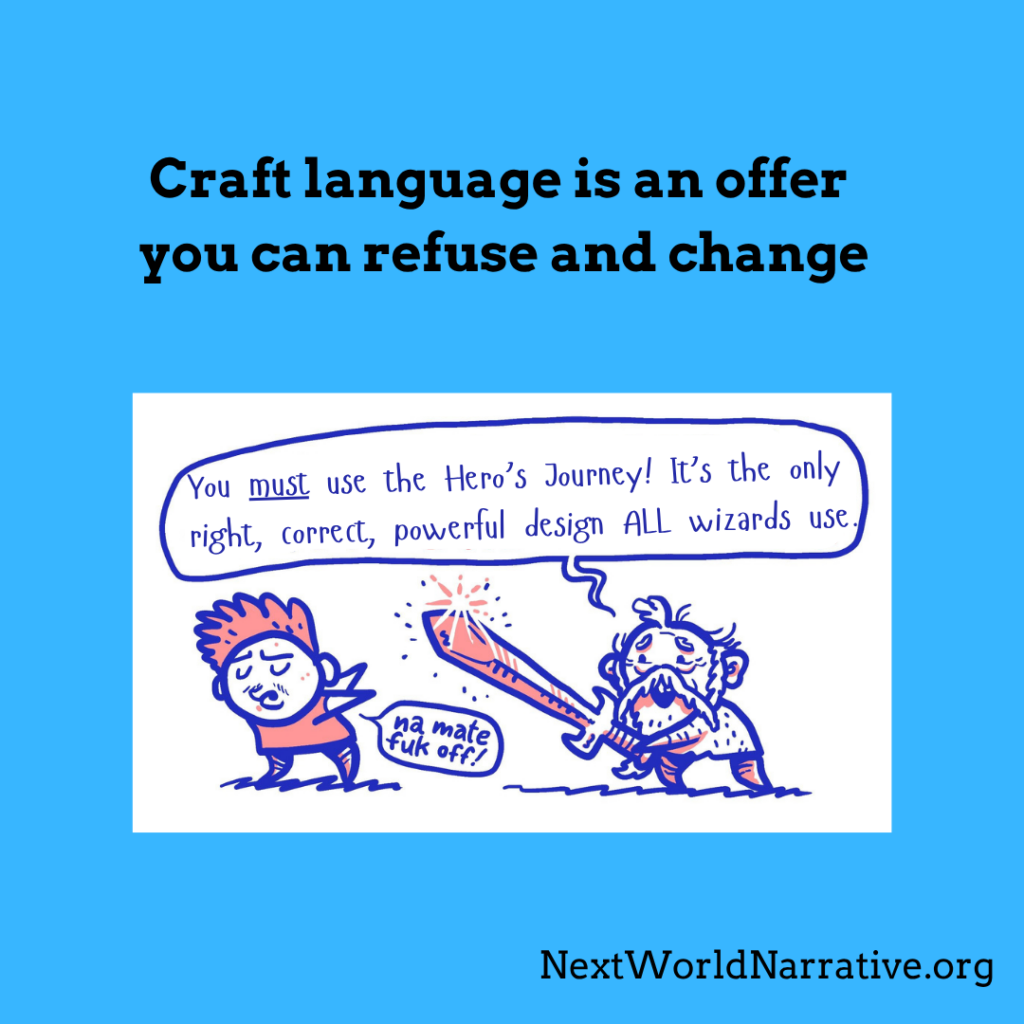
Craft Language is an Offer You can Refuse and Change
I went to an improv session on the weekend. Jamie gave us an exercise where we offer our partner something to do together (for instance, “let’s go to a rock band concert”). If our partner said yes, we’d improvise being at a concert together. If our partner said no, we’d try another offer. Our task was to notice our partner’s response. How did they say yes or no? Did their eyes light up? Did they close down? I noticed that whenever they said ‘no,’ I loved it. Not that I preferred a no to a yes. A yes gives information about what they like and love. But a no lets me know what doesn’t bring them alive. A no also helps me get to know them.
I’ll share something about my brain with you. I automatically think about future trajectories based on present and past information. A new bit of information and the trajectories shift. I learnt to hide this way of thinking. If I mentioned how action X could lead to outcome Y, people would screw their face up. It seems some folks have no conception of how a mind could do that. They assumed I must be acting according to their world logic: I must be making big, false, claims about something I couldn’t possibly know. I must be paranoid. I must think I could do magic. I knew the steps along the trajectory, so their views didn’t change my mind about the insight. They did, however, for a time, contribute to me not sharing my thoughts. I may have done this to avoid disdain. I know I did this because I had no idea how to explain that my world is different to theirs. It’s not magic or some superpower. It’s as regular as my cup of tea, and lots of people drink tea.
Time isn’t one-way, either. I looked back to the past for explanations of the present. I remember when I was a teenager. One day, mid-afternoon, I suddenly felt despondent and self-loathing (more so than usual lol). I knew I didn’t feel that way when I woke up, so I traced my steps through the day. I realised that the negative thoughts and feelings emerged after reading Dolly Magazine (it was different then). I stopped reading those teen magazines. I had a little less prodding me feel unnecessarily down about myself.
When I was teaching interactive storytelling, game design, screenwriting, whatever subject it was, I noticed how students responded. I learnt what happens when I teach this way and that way. If I change the game design props from a chess board to plants, the nature of the games they make are considerably different. Then, later in the course, the kinds of games they pitched changed, and so on. I made new offers, learnt new paths, and gradually built new trajectories. I thought about the offers they got from teachers in other courses, and from fellow workers after university. Peers who will be hellbent on saying bullshit like money is the only reality, professionals must ghost people, and so on. I thought, what I can offer now that might stay with them in the future. I don’t define their future. But knowing what is highly likely to be coming, I can give them a different present. A present that lets them know they don’t have to go with what they’re offered. A present that encourages them to know what brings them alive and closes them down.
We don’t have to say yes to craft methods that don’t bring us alive. We can say no to their premise that design is fixed and we have no say in it. We can say no to their claims about the urgency of it all, and how their designs are the only way to be professional. In Strike!, documentary maker, historian and activist Jeremy Brecher details the history of (American) worker strikes. ‘If they refuse to work,’ he explains, ‘withdraw their cooperation, or take control of their own activity, “they have the power to reshape society.”’ Refusal says we don’t want this anymore and it gives space for what we do want. In Mohawk Interruptus, political anthropologist Audra Simpson details how the “people of Kahnawake” ‘had refused the authority of the state at almost every turn.’ Simpson calls it a ‘generative refusal.’ We can generate the world we want.
Recently, I ran public workshops on how we talk about craft. They were about the words we use when talking about screenwriting, game design, literature, development, peers, audiences, and so on. For instance, how continually using words like “commandment,” “physics,” and “natural law” to describe design can diminish a creative’s sense of agency. Calling different creative approaches a “sin,” “deviant,” or “unprofessional” not just delegitimises legitimate ways of creating, but also diverts many creatives away from their only way of flourishing. Sticks and stones can break my bones, but words can make me think I deserve it.
I ran the sessions because I noticed how alive I felt when I realised the words most story gurus use were closing me off what to really helps me, and that I could say no to them. At first, I noticed a pattern across many storytelling and game design manuals. I thought that the repetition of the same methods was a sign (as the authors claim) that they’re covering the good, great, true way to design. But the methods didn’t revolutionise my practice. No, it was when I noticed another pattern across the manuals that my practice evolved. They all use the same persuasive tactics to make me think they have the truth. Once I realised their tactics, the methods weren’t obligatory anymore. I didn’t have to go with their offers on how the world, creativity, and design works. I was free to find what suits me, and I did! I wanted others to know that, too. I put together preparation reading, and got to work.
It was a risk running the workshops because I wasn’t sure: 1) how many folks would be interested in the topic (or the way I framed it); 2) if folks would sign up even though it was direct to me and not through some big conference, festival, or institution; 3) if my costs would be covered as I deliberately made the workshops a choice of pay a relatively low fee, pay-what-you-want, or free. I ended up with colleagues from across three states in Australia, three states in the USA, UK, France, and Wales. I also had colleagues who couldn’t or wouldn’t make it, but wanted to chat via Zoom or email. Those interested included authors of screenwriting books, filmmakers, doco-makers, game designers, screenwriting university educators, researchers, and more. I knew them all, from my work across the last couple of decades and new colleagues. (So, I need to figure out how to communicate the insights to strangers, too.) My expenses were covered (but not my time). I loved learning what brought my colleagues alive and what they’re not interested in.
I shared the trajectories I see, backed up by my lived experience and research. I realised that there are very good reasons why some of the language used is appealing. I’m not talking about their persuasive strength. I’m talking about how their promises allude to positive things about the world. Promises they don’t deliver on. We can say yes to the promise and act on that, and no to the false practice they offer.
Outside of the workshops, I also noticed that a common response to the problem of Story Gurus giving bad advice is to police who gets to be a Story Guru. Undermining their power is helpful. What I think is also (even more) helpful is to know how it’s bad advice, and to promote a diversity of creative voices, not just a change of guard.
In the final workshop, I shared a tool to understand the relationship between the way we talk about craft, our everyday lives, and what is happening in the world. I have since then also figured out a way to systematise the ways to respond…using playfulness! Which is something one of the participants highlighted. Design orthodoxy language diminishes playfulness. But we know that creativity thrives in playfulness.
I noticed that the people who stayed to the end of all the workshops had shared qualities:
- Pain from being creatively and personally impacted by oppressive craft language
- Pain from actually, or concerned about, negatively impacting peers
- Yearning to have allies in their work and feeling emboldened to do something
- Yearning for a system to use in their own practice, teaching, & research
Based on that interest, I’m working on a short book version. I want it to bring the conversation about design back to how we can all flourish…how we can all feel alive when we create. I have a publisher who is interested and able to do this with a short turnaround. With that, I’d like to know what comes up for you. What are your ‘nos,’ ‘yeses,’ and ‘yes ands’ to anything I’ve said (and not said). This information helps me bridge my world with yours. Feel free to message me! Until then, yarrrrr, craft is an offer we can play with!
How to cite this page:
Dena, Christy (2026) “Craft is an Offer You Can Refuse and Change” Loving-Change Storytelling, 3 September. Last updated 28 October, 2026. www.lovingchangestorytelling.org/articles/craft-is-an-offer
Why We’re Changing the Story of Creative Development – Part 1
Everyone on this planet is engaging in change in some way. For those who didn’t notice, or misread, like a bit of heat, or want some fertiliser on their revolutionary garden: here are some reasons why more and more of us are working on a new status quo of creative development.
You see, the issue is the default methods and techniques of design orthodoxy are unfit for the world we’re in. When we say design orthodoxy, we mean the fixed, prescribed, narrow, ‘right,’ design processes we’re told we must use. They’re what recently (in the last 40 years) became the factory settings of craft, the default mode, and ‘common knowledge.’ And yet, the approaches are already in their cultural autumn. In part because they became popular through manipulation and tapping into status quo views, not because they genuinely enhance the creative process. The signs are there for a pivot.
We need a new story of creative development because:
Professional Pushback Against Design Orthodoxy
Design orthodoxy proclaims itself to be the bee’s knees. While there are still newcomers, some educators, researchers, and executives who believe the big claims of story gurus, most steer clear. In his article, “Friends Don’t Let Friends Write to Formula,” ex-screenwriter and industry educator Corey Mandell relates how he was hired by director Ridley Scott to work on a screenplay. Scott warned him: “If you try to write this script to one of those bullshit film school formulas you’ve been taught, I’ll fire your ass and hire a real writer.” In Beyond the Hero’s Journey, BAFTA- and AWGIE-winning screenwriter Anthony Mullins explains that, “I don’t know any professional screenwriter who routinely applied it [Hero’s Journey] in their screenwriting practice. I knew a lot of beginning screenwriters who tried to use it with varying success, but when it came to writers who make a living from their craft, they had moved away from the Hero’s Journey and found their own way of tackling a story.” It is a helpful signal to see how much push back there from those who’ve “made it.” But we also need to listen to the criticisms of those who don’t survive or don’t want to be in conventional film, TV, and games. They called the alarm, too, and sooner.
Pivot: Craft now defaults to methods and techniques for finding your way of tackling story. (For example: Pilar Alessandra‘s Guidance on When and How To Break the Rules; Dannenbaum et al’s Insights into balancing personal connections and challenges; LaPensee ́ et al’s Enacting Sovereignity Method)
A.I. Has Made Formulaic Writing The New Floor
Because of the assumptions story gurus popularised (more on this in another article soon), some creatives think that the design process is purely about finding and using what is already out there. Generative AI is built on the stolen use of a massive amount of stories, and guided by trainers. The majority of these trainers, both writers and not, draw on design orthodoxy and status quo thinking. The writing that AI produces, therefore, is highly formulaic. Ironically, this raises the bar. Design orthodoxy is now the bare minimum and can be produced in seconds. In a recent social media post, writer, journalist, and editor Samantha Dunn explained that “AI has already completely changed the game. It has permanently upped the stakes on what we writers must offer our audiences. In seconds, Gemini, Claude, ChatGPT or whatever can deliver standard service journalism […] Yes, there are sometimes issues of accuracy, but the larger point here is that it’s PASSABLE” (original emphasis). So, “[w]hat feature writers MUST deliver is their human discernment — their observations, their judgment, their conclusions drawn from experience and research. Writers have to be HUMANS talking to other HUMANS. Writers must deliver insight. Good writing = good thinking.” Likewise, on an episode of their co-run podcast Scriptnotes, screenwriter Craig Mazin explains that AI will only affect some writers: “If you are mediocre, maybe you are going to be out of a job, but you are probably going to be out of a job anyway because that’s how mediocrity works.” I read this situation as a opportunity. Now more gatekeepers want uniqueness. Now our subjective insights are becoming the new norm.
Pivot: Craft now defaults to methods and techniques to heighten our skills and draw on our uniqueness (For example: Corey Mandell’s Creative Integration Process, Linda Aronson’s Vertical & Horizontal Thinking Balancing Method, Sarah Fawn Montgomery’s Disabled Form Method, and Sonya Huber’s Naming Your Many Voices Method)
There Have Always Been A Wide Range of Methods
While design orthodoxy uses tactics to hide or dissuade you from seriously engaging with the variety of design methods available, the fact is they’ve always existed. There have always been the exceptions to the rules (sorry, McKee, “principles”™️). Indigenous storytelling pre-dates Aristotle and engages with a “timelessness” that isn’t about freezing everything in a moment and copy-pasting it into infinity. There are Eastern methods, at least six kinds of the Heroine’s Journey, passive protagonists, unchanging protagonists, queer forms, non-linear, different shapes, and more available and emerging. We live in a pluriverse not a monoverse. This means the skill missing from design orthodoxy is that of choosing structures, methods, techniques, mixing…and generating your own.
Pivot: New status quo where everyone learns the skills to choose which approach may suit their project context. (For example: Anthony Mullins’ Method to Choose an Arc According to Character Choices; Jane Allison’s Visual Method of Choosing a Structure; Linda Aronson’s Ensemble Size and Social-Cultural Method to Choose the Right Parallel Narrative, and Stayci Taylor’s Method of Generating a Queer Journey)
Demand for Impact Storytelling
There has been a growing call for creative works, including entertainment, to deliberately engage with climate and social change storytelling. The Hollywood Climate Summit, Climate Story Labs, Playing for the Planet, Represent Justice, are examples, and there are of course more. But by default, design orthodoxy excludes impact storytelling methods and techniques. This is because the underlying premise of design orthodoxy is that design doesn’t carry meanings and is separate from society. By default, design orthodoxy also excludes designing to context. The premise being that methods and techniques do not change, people don’t change, and every project and every person is the same or should be. This absolves creatives of any responsibility and impact is relegated to non-fiction productions and other educational content. There is utility in one corner and entertainment in another. The shift is to return to an understanding of how we’re all connected and we all co-design the world, whilst also drawing on the insights of what the invention of fiction enabled.
Pivot: Development defaults to deliberate meaning design, and all projects measure social and environmental impact. (For example: Learning for Action’s Media Measurement Framework; OKRE’s Unified Games Impact Framework; and Responsible Media’s Measuring Media’s Footprint and Brainprint — I’ll share my craft-oriented transformation scope shortly, too!)
Activists Use Story Design in Narrative Change Campaigns
There has been a growing use of dramatic storytelling techniques in activist campaigns. Specifically, in narrative change campaigns, where the goal is shifting a damaging deep cultural story in society (such as “people are poor because of their personal choices”). Understandably, but unfortunately, campaigners often use story design orthodoxy. By default, design orthodoxy excludes meaning design. The premise of design orthodoxy is that stories don’t say anything, dramatic techniques are discovered not made, and everyone is naturally change-antagonistic and values antagonism. Audre Lorde gave us a great way of saying this: ‘the master’s tools will never dismantle the master’s house.’ This means creatives keep upholding the same deep cultural narratives and the same designs (they can only change the degree of spectacle, art style, and who is in the cast, crew, or audience), and activist campaigns send out mixed, or undermining, messages. We need to make meaningful design what travels the furthest, not contextless-design.
Pivot: Development defaults to deliberate meaning design, the skills to choose which approach may suit your project context, and all projects measure social and environmental impact. (For example: Good Energy’s Climate Reality Check; Roxane Blouin-Payer et al’s Gameplay Verbs and Antonyms Framework, and Sabine van Mering’s Promise Motivation Method)
Design Orthodoxy Isn’t About Quality
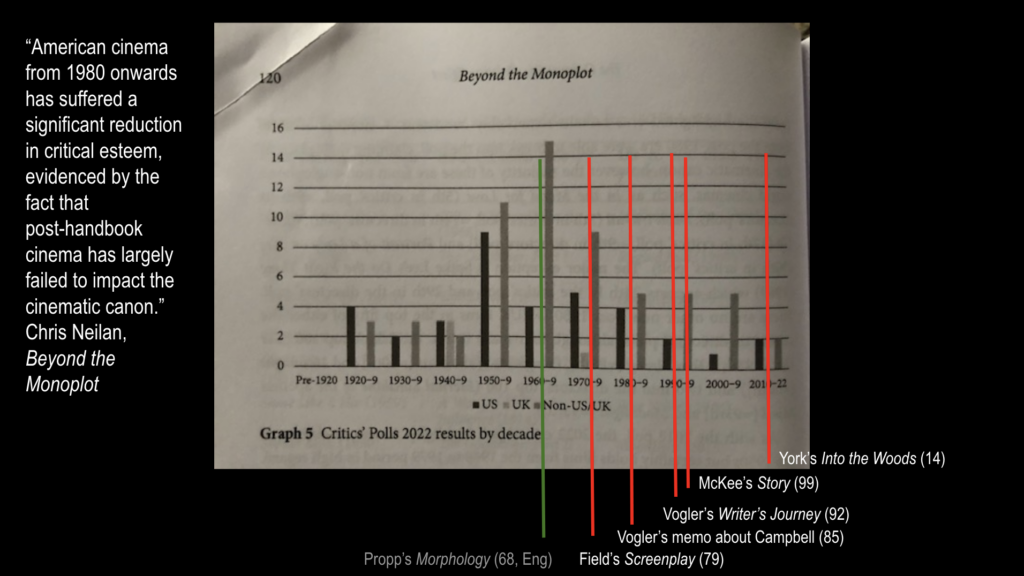
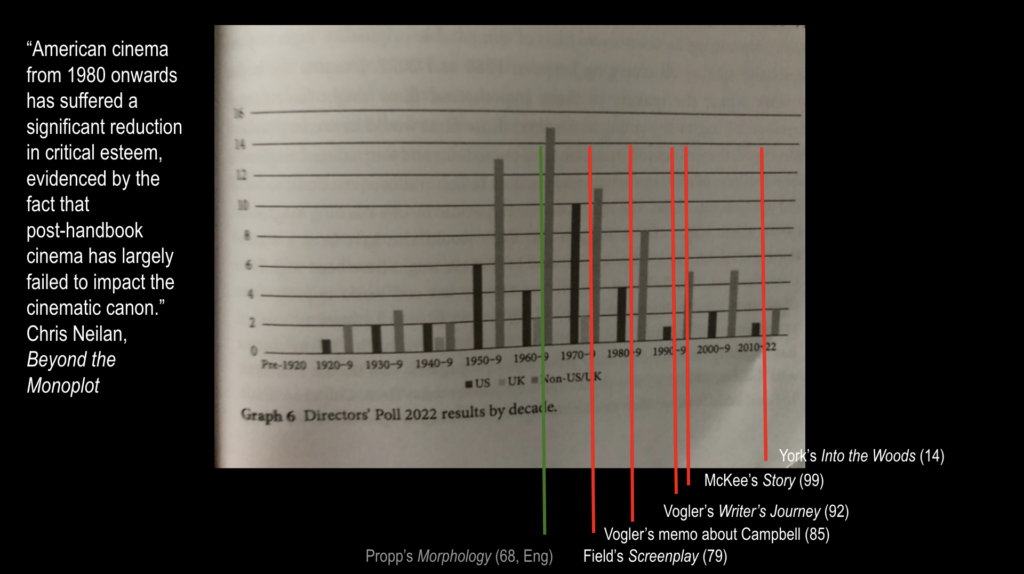
Design orthodoxy makes big claims about the proper way to create, and dissuades you from using other methods by framing them as the opposite of good, worthy, and valuable. In his book Beyond the Monoplot, screenwriter, teacher, and researcher Chris Neilan presents his quantitative analysis of critical consensus and peer esteem of feature films from pre-1920 to 2022. He showed that there has not been a significant increase in quality since the introduction of the methods and techniques of story guru manuals. In fact, critical regard is much lower compared to screenwriting pre-orthodoxy. Also, Neilan showed that before design orthodoxy was popularised, feature films enjoyed both critical and box office success. Afterwards, you’re more likely to have one or the other. The story gurus created a self-fulfilling prophecy. Investment, funding, and script assessors often draw on design orthodoxy even though it doesn’t indicate quality, because they don’t yet know how else to examine the works. We need to explore and spread methods for assessing without stencils, and put back in what is important.
Pivot: Development rejects false binaries such as art versus commerce, impact or entertainment, and instead focuses on responsible resonance and transformation, and other areas of concern. (For example: Centre for Public Impact et al’s Good Storytelling for Systems Change; Felicia Rose Chavez’s Anti-Racist Writing Improvements Objectives; Harmony Labs’ Values-Distinct Audiences)
Design Orthodoxy Doesn’t Increase the Likelihood of Success
Design orthodoxy makes big, false claims. The fact is, formulaic methods and techniques do not make everyone’s project better. As screenwriter and screenwriting teacher Neil Landau says in his book, The Screenwriter’s Roadmap: “If there was an absolute formula, every screenplay would be brilliant—and we all know that’s not the case.” As novelist Samuel R. Delaney says of different approaches in Pocket Workshop: “Masterpieces have been written with both methods. Both methods have produced drivel.” An analysis of Australian film success found that novice filmmakers earned a higher international ROI (return on investment) compared with experienced filmmakers. The reason being experienced filmmakers tended to become confidently myopic and not recognise or adapt to new opportunities (Rossiter & Mastoris). Despite it’s claims, design orthodoxy hasn’t lifted all boats. We need to decenter one-size-fits-all approaches and nurture what actually aids mutual flourishing.
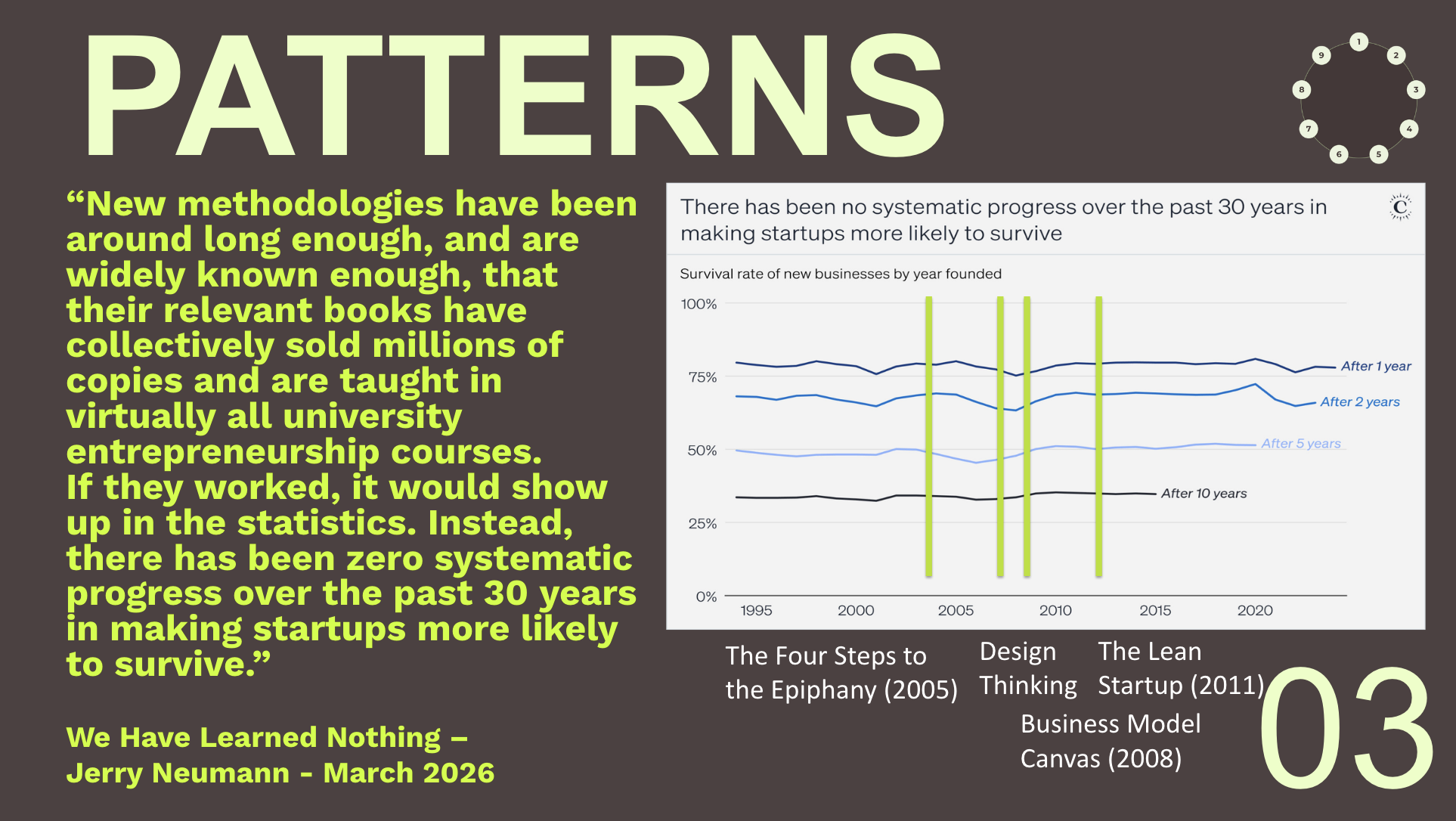
The lack of orthodoxy impact isn’t specific to creative productions. I attended Jane Korneyko’s talk at StartSpace a couple of months ago, and she detailed the research into how bestselling entrepreneur books (such as The Four Steps to Epiphany, Design Thinking, The Lean Startup, and the Business Model Canvas) have made zero impact on failure rates of startups. [Image below provided by Jane.]
A quote on her slide from Jerry Neumann (2026) says: “New methodologies have been around long enough, and are widely known enough, that their relevant books have collectively sold millions of copies and are taught in virtually all university entrepreneurship courses. If they worked, it would show up in the statistics. Instead, there has been zero systematic progress over the past 30 years in making startups more likely to survive.”
These are just some of the reasons why many of us are building a new story of creative development. There are more reasons why many of us are taking action, and more will keep emerging (tell me your reasons!). In the meantime, we’re building a new normal that is contextual, deliberate, impact-conscious, and about mutual flourishing…as a starting point.
How to cite this page:
Dena, Christy (2026) “Why We’re Changing the Story of Creative Development – Part 1,” Next World Narrative, 6 August. Last updated 11 August, 2026. www.lovingchangestorytelling.org/articles/why-were-changing-the-story-of-creative-development/
Library Updates: 1001 Faces, Liberation Wheel, and Beyond Victory Points
Here are the latest additions to our Liberatory Craft Library! Craft tools, inspiration, & insights for our next world. Some just remembered, some newly discovered.
📖 Books
👉 Albert Camus’ Create Dangerously
“Camus’s powerful lecture, as relevant today as ever, argues against ‘art for art’s sake’, while his Nobel Prize speech brilliantly sets out his vision of the artist’s role and responsibilities.”
👉 Damien John O’Meara’s Queer Stories in Australian TV drama: Production Culture, Policy, and Distribution
“This book examines how queer representations are negotiated by creatives and executives for distribution through mainstream television networks.”
👉 Ellen Kirkpatrick’s Recovering the Radical Promise of Superheroes: Unmaking Worlds (free & paid)
“Why, when set against otherwise unbounded, and often extreme, transformation—human to machine, human to animal, human to god—are certain categories seemingly untouchable?”
👉 Maria Tatar’s The Heroine with 1001 Faces
“The Heroine with 1,001 Faces dismantles the cult of warrior heroes, revealing a secret history of heroinism at the very heart of our collective cultural imagination.”
📜 Articles
👉 Alyssa Smith’s ‘Whitewashing v. Blackwashing: Structural Racism and Anti-Racist Praxis in Hollywood Cinema‘
“This study aims to dissect how whitewashing and blackwashing differ, as well as discuss how blackwashing succumbs to the racist history of the Hollywood film industry despite its attempt at leading a brighter future for Black representation in film.”
👉 Amber Case’s ‘How Design is Governance‘
“At a fundamental level, all design is governance. We encounter inconveniences like this coffee shop every day, both offline and in the apps we use. But it’s not enough to say it’s the result of bad design. It’s also a result of governance decisions made on behalf of the customers during the design process.”
👉 Amity Paye’s ‘Belief Arc‘
“What does it take to change people’s hearts and minds at scale? How do we meet people where they’re at, while staying laser-focused on where we want them to go?”
👉 Collective participants’ ‘Manifesto for Community Film Distribution and Exhibition in Latin America‘
“Collective Document Created by 183 Participants from 12 Countries at the III Latin American Forum on Film and Social Impact in Bogotá, Colombia, 2024.”
👉 DS4SI’s ‘No More Fairy Tales‘
“How do we go about telling ourselves the truth? How do we intervene in our own narrative devices? What stories have swallowed whole…about ourselves, about heroes and villains, about what it means to win? There is gut wrenching work to be done here.”
👉 Stayci Taylor’s ‘Not getting your story straight: queering heroes’ journeys and heteronormative timelines‘
“This article offers queer temporality as a lens through which to unravel the 12 steps of Vogler’s hero’s journey, informed by queer theory’s critiques of the 8 steps of the heteronormative life journey.”
👉 Quanice G. Floyd’s ‘We Need To Talk About Power & Control In The Arts And Culture Sector‘
“In this article, I’ll introduce the Arts & Culture Power and Control Wheel and the Arts & Culture Liberation Wheel. I’ll begin with the historical context behind the wheels before digging into the frameworks themselves.”
📺 Audio Visual
👉 Amabel Holland’s ‘Do Board Games Need Victory Conditions?‘
“Game designer Amabel Holland asks what kinds of human things the medium of board games can express and explore once we let go of winning or losing as sources of meaning.”
👉 James Dunlop’s ‘What the Gurus Leave Out‘
“If you’ve ever wondered whether successful writers possess secret knowledge (or simply a higher tolerance for ambiguity, repetition, and occasional self-doubt) this video may help.”
The Landscape of Narrative Design Activism
Many of us are reaching for change in ourselves and the world. We’re reaching for each other, and participating in positive social transformation.
We don’t just do this by protesting in the streets (though, this is important!). We do this in every aspect of lives. That donation? Sure. Petition? Yes. The conversation with your taxi driver, or rider? Yep. That policy change at your work? Ah-ha. That article you wrote? Yep! The stop work campaign you participated in? Yep! The diverse characters in the game, film, TV show, or novel you created? Yes. Every part of our lives is open to change.
Narrative design activism is about the action we take through the creative projects we put out into the world, and, importantly, how we make them.
It’s narrative design activism to highlight to overtly include change that is channeled into how we make (our games, films, TV shows, novels, plays, and more*). This is because it isn’t always part of creative activism. Let me explain.
Creatives can be activists in some or all parts of their life and practice. There are areas that people default to putting their energy into more than others. To help illustrate this, I’ve listed patterns I’ve noticed. (Let me know your thoughts!)
Everyday not Entertainment
I know plenty of creatives who are activists about issues (such as changing for the climate and social inequalities), to various degrees, in their everyday, and not with their creative work. Sometimes this separation is unconscious because they learnt to silo different parts of their self (that was me!). Sometimes it is a deliberate split because they will risk their livelihood and their lives. Sometimes it is a deliberate split because they’ve erroneously been taught that design is not part of life. Sometimes it is a deliberate separation because while they know their creative work is oppressive and uninspiring, they need the income of conventional design work. Sometimes it is deliberate because they want to maintain an oppressive status quo in a creative industry that benefits them, or promises to.
Faces not Forms
There are those that see their their characters depicted, casting, and crew as activism (whether it is fiction or non-fiction), and they still employ design orthodoxy to make their projects. See Henry Lien’s “Diverse Story Forms and Themes, Not Just Diverse Faces.” This is when folks make hard-won inrounds to having a seat at the table, despite the bias and pushback. This is also seen with initiatives where marginalised folks gain entry to the industry through special programmes, or are given their own niche events & audiences. The idea being that the creative changes to fit the industry, not the industry changes to include all of who they are. Sometimes this is an unconscious separation because they’ve erroneously been taught that they only have agency with implementation, not every aspect of design. Sometimes this is a conscious separation because while they know their creative work is maintaining orthodoxy, it is the only element gatekeepers/stakeholders would approve and they know it is making a contribution anyway. Or, inversely, they wanted it to maintain orthodoxy but they were “forced” to include diverse characters, storylines, cast, and/or crew. Sometimes it is deliberate because the creatives want to maintain an unequal status quo for their benefit, or the promise of one, while also benefitting from being seen as progressive. See greenwashing, pinkwashing, blackwashing, etc.
These latter folks are often on funding/investment panels because of their activism, but they find a way to “reluctantly” reject projects with diverse forms, goals, & audiences. I despair at how common this is. But, I also know that they were taught (by society and creative projects!) that unequal treatment is the only way to survive this world. Our activism needs to include their liberation as well.
Industry not Practice
There are also creatives who aren’t using their creative works or their processes for activism, but take action about their industry to try and make things better. They take action on workers’ rights, pay rates, content quotas, open access publishing, respect for different roles, reaching audiences, and so on. Sometimes this is a first foray into activism and is appealing because of the potential personal (or group) benefit and the support of peers. It can be an onboarding to doing more. Sometimes these folks keep the separation because they want to contribute to change while (for the promise of income security) maintaining their professional status with studios and their oppressive practices. Sometimes these folks want to keep enacting and benefiting from oppressive creative practices, and also be seen as progressive. Sometimes there is this separation because they’ve erroneously been taught that design doesn’t change, only the industry around it. Sometimes there is this separation because they’ve erroneously been taught that creativity is about certainty, and so it is best they stick to the design they know.
Impact Documentary not Impact Entertainment
There are creatives and stakeholders who take action with the stories they tell, the design process, and their audiences, but only in documentary, education-based works, and serious games, not entertainment in general. Sometimes this separation is because creatives and stakeholders have been erroneously been taught that people don’t learn from entertainment. Some of the most impactful films, TV shows, and games were not made for impact. Take Jaws as an example, and it’s impact on shark policy and public fear of deep water (and for me, dipping my toe on the floor from my bed). Sometimes there is this separation because funders are limited by government policies that don’t allow them to invest in anything other than hedonism. Sometimes this is this split because investors have been erroneously taught that creative orthodoxy is the only market. Sometimes there is this split because creatives who work in entertainment fear they won’t be taken as seriously by their activist peers. Sometimes there is this split because creatives haven’t yet learnt how to be responsible with their design and make something undeniably entertaining.
Status Quo not Structure
There are people, including activists, who aren’t working creatives but who use storytelling in their campaign speeches, videos, and even use existing creative projects. More often than not, despite their goals of changing the status quo, they often use status quo design. Sometimes this separation is because design orthodoxy is what reaches them. Design orthodoxy is uplifted by the status quo and so reaches newcomers and those who aren’t inartistic professions. But, it needs to be said, design orthodoxy is not what many creatives work with, and their skewed representations of craft have been the subject of design activism within screenwriting, playwrighting, literature, as soon as the new oppressions were invented. Sometimes this split is because they’ve been erroneously told by trusted creatives who themselves have been misled about how design works. Sometimes there is this split because they’ve erroneously been taught that orthodoxy is the only entertainment market, even though there are activists sharing data on different designs for different audiences. Sometimes this is because the activists have taken on the oppressive ideas informing in design orthodoxy, and so they don’t see any contradiction.
Attuned without Accountability
There are creatives who are activists about the processes, methods, and techniques to the extent it frees them to design their way. This often excludes any interest engaging with prosocial design (in their fiction or non-fiction, or even in their peer relationships), or for social change goals. Sometimes this separation is because the issue with design orthodoxy isn’t just that it is anti-progressive, it’s that it thwarts most peoples’ creativity full stop. Sometimes this separation is because finding a process attuned to them is their first step on a journey of creative liberation. Sometimes there is a deliberate separation because they want to maintain and benefit from creative orthodoxy, but they personally can’t do conventional processes. Sometimes the split is because they crave novelty but they loudest voices around them steer that interest in the direction of a selfish status quo.
Aligned Practice
There are creatives that don’t silo their activism but instead continously attend to it, to the best of their ability, where they can, in every aspect of their creative and personal life. This is the least common because of impediments mentioned above.
I’ve been through every one of these areas of focus and I’ve found that what helps me align all of them. (Which doesn’t mean I’m perfect at all!) I’ll quickly share what that is rather than leaving the conversation there!
Narrative change activists talk about it, and so too do system change designers, and information communication researchers, among others. It’s got various names, including a “deep narrative,” “mindset,” “cultural narrative,” “paradigm.” This repetition doesn’t mean it is right and always will be. It means that there is a community of interest around it, lots of energy being put into it, and it resonates with me.
It’s about the underlying, cultural stories we tell ourselves about how the world works. It gives us the deep logic — the underlying worldbuilding or theme in writing terms — that contribute to what we do in our everyday, with our peers, our craft processes, the structures and mechanics we use, what we make, and so on.
I find that attending to deep narratives gives me a continuity of practice and cumulative insights.
I’ll be sharing the work people have done in this space and my own, too. I’m running a workshop on the restricting and liberating deep narratives that inform how we talk about craft, and will be sharing more in other formats as well. I’d love to hear your thoughts!
* There are those in games familiar with the term “narrative designer” as a noun to describe a job which involves, among other things, being a ‘team synthesist;’ playwrights familiar with the term “dramaturg,” which involves, among other things, attending to the meanings of the collective representations; and literary writers familiar with the term “narrative design” to include the form work of writing. I’m using the term less as a noun and more to denote the focus on designing. With the emphasis on the various meanings (narratives) associated with our design work on teams, industries, cultures, and more.

How to cite this page:
Dena, Christy (2026) “The Landscape of Narrative Design Activism,” Next World Narrative, 23 June. Last updated 22 July, 2026. www.lovingchangestorytelling.org/articles-2/the-landscape-of-narrative-design-activism/
Thank you to Heidi and Richard for your contributions!
Library Updates – De-Coupling, Exercises, Transformative, Impact
Here are the latest additions to our Liberatory Craft Library! Some just realised, some newly discovered or recommended, and some just remembered.
✊ Why do this? We’re guided by mutual flourishing: which means recognising that this is collective work and we’re all responsible for co-making our creative cultures and the world.
📜 Articles
👉 Ivan Pintor Iranzo’s “From Rhetoric to Archetype: Screenwriting Manuals”
“in what ways do screenwriting manuals and analytical studies complement each other and how do they exchange contributions?”
👉 Shane Agid’s “How What We Ask Shapes What We Can Imagine: De-Coupling Design and Punishment”
“I focus on what shaped these questions, and how the questions in turn shaped the possibilities for design that emerged from them, in ways that matter deeply to the imbrication of architecture, design, and punishment.”
📖 Books
👉 Lucy Ives’ Three Six Five: Prompts, Acts, Divinations
“Many exercises take the form of play, encourage collaboration with friends, strangers, and non-human beings, and operate off the page, often in the world, in the spirit of discovery rather than result.”
👉 Sarah Lynne Bowman, Kjell Hedgard Hugaas, and Simon Brind (Eds)’s Implementing Transformative Role-playing Games, Uppsala University
“This textbook explores implementation practices for running transformative analog role-playing games, such as transformative leisure, educational, and therapeutic applications.”
📺 Audio Visual
Victor Navarro Remesal’s talk “The Making of Zen and Slow Games”, Center for Digital Play, IT-Universitetet i København
🔖 Reports & Guides
👉 Kemi Alabi et al’s “Building Irresistible Movements: Best Collaboration Practices for Organizations and Visual Artists”
“How can organizers and artists best work together to harness the power of culture and create a more just world?” (through Monica trinidad’s ace Youtube video “Artists are workers | getting paid to make art for social change” https://lnkd.in/gR4KCJxB)
👉 OKRE & UKIE’s “Building a Unified Framework For UK Video Games Impacts”
“It provides research frameworks for the sector’s wide ranging impacts along with a reframed sector definition and interactive supply chain visualisation.”
👉 UNESCO‘s “Re|Shaping Policies for Creativity: we share, we act, we build”
“Digital transformation has fundamentally reshaped the creative landscape. Never has creative content been so abundant, nor the tools so widely accessible. Yet for many, stable employment and fair pay are out of reach. … These challenges urgently call for collaborative global governance.”
Explore these and more in the Liberatory Craft Library. 🙂