The Difference Between Perceived and Produced Structure
A liberated designer knows that we flourish when we nurture our unique ways of creating. Currently, the loudest voices in design are the ones who don’t themselves make. But a liberated designer doesn’t give anyone else authority over their creativity.
Today’s chat is about the overrepresentation of reader voices, how it skews people’s understanding of development, and what development is actually like.
I’m not talking about fans, necessarily. Yes, I’m talking about people who experience a creative work. Mostly, though, I’m talking about people who assess creative works, formally or informally. It’s their voices that currently have an inappropriate amount of influence over creatives.
Most of the loudest voices in development are not responsible for the writing, design, the crafting of the project. They’re assessors, producers, marketers, business advisors, and even lawyers. Their voices are important. But their influence is outsized because most of them don’t know (or care enough to learn) the difference between how a project appears to have been made and how it is actually made. Let alone how to faciliate mutual flourishing.
Indeed, the majority of popular screenwriting books are written by people who maybe have made one or two films or TV series. But, they’re mostly misleading, unfortunately, as Chris Neilan will expose in an upcoming article. Yes, some have had roles assessing screenplays as a ‘reader’ for a studio, but all refer to the end product as their evidence for action.
But a final script and released film, TV show, game, or novel is not the same as knowing how it is made.
To be clear, I’m not trying to gatekeep here. It’s important to me that people who are deliberately marginalised out of “industry” are heard. So, to me, credits are not a requirement for being listened to. People speak from different positions. I’m talking about how the process of making as been skewed to fit decisions people come to based on the result of making.
Screenwriter (films) John August talks about this in the podcast, Don’t Be Alone with Jay Kogen. John says that (manuals like those written by McKee and Field) ‘in general, they’re not written by people who actually did the job. They’re written by people who like observed a bunch of movies.’ In reference to their co-written book, Scriptnotes, screenwriter (films, TV) Craig Mazin adds that ‘we we try as best we can to talk about what we do, which is to start with nothing. And get to something. And the people that don’t write for a living and then write books about screenwriting just dissect things that already exist. That’s doesn’t help you when you have nothing.’
Think about the Hero’s Journey, specifically Joseph Campbell’s monomyth. The folktales from different countries, cultures, and centuries (that Joseph Campbell analysed) were not conceived using his chapter-by-chapter run-down on the stages of a hero, or Vogler’s handy infographic. I have no idea how they were developed because neither Campbell or Vogler talk about the creative processes that resulted in the journey they perceive. Now, if you believe Campell’s interpretation, and think that it’s a model that is within us all, or available to us through higher means, then why not talk about how we access that? Isn’t the point to find our own connection, not just copy? Julia Cameron made it about connection. She shifted attention away from the journey depicted on the page or screen to the Artist’s Way.
I’m talking about this because the overrepresentation of end-product voices has skewed people’s understanding of the creative process. Narrative designers try to shoehorn (is that term too old now? Is it illegal in games?) their emerging project into the end design. They feel shame and self-loathing for not being able to fit the prized mold. I know I did. Testers and assessors also get disappointed with the contrast between your work-in-progress and a familiar end product. Testers often think that the end-product is the only signal of skill. Creatives end up learning skills that lead them away from their flourishing. They end up inverting insights.
“Structure is the Symptom”
At the keynote I gave at the Joint Screenwriting Research Network and Sightlines Festival last year (2025), I mentioned the difference between how people think I’ve designed my games and how I actually have. For instance, I had a colleague respond to my Elder Spider character, saying that I was using a “mentor” character, and another colleague citing an “impact” character (ala Dramatica). Since I am versed in both, it is possible they were a subconscious influence. The process of creating was very different, though.
I didn’t start with an archetype. Instead, I started with what I wanted the players to experience: what it’s like to have someone support you because I haven’t had enough of that and it’s amazing when it happens. I also had a lovely brain trust advisor who had shared stories of elder activists. I wanted to value age in part because I’m getting older, I miss my mum who has passed, and I think we need all generations involved in taking action. I ended up doing what many pre-built structures would approve of. But I didn’t start with that or try to do that. Those archetypes don’t capture the wonderful mix of experiences and ideas specific to my journey. Those archetypes didn’t guide me to design the way I did.
Author and critic Samuel R. Delany talks about this disconnect, too. In his essay, ‘Thickening the Plot,’ in Pocket Workshop, Samuel says that discussions of plot often refer ‘to an effect a story produces in the reading’ (original emphasis). But, he says, ‘discussion of effects is only of limited use in a discussion of causes.’ To explain the difference, he talks through the process of writing. Samuel explains ‘that the writing down of words about my imagined vision (or at least the choosing/arranging of words to write down) causes the vision itself to change’ (original emphasis). That’s right. Our idea of the story, game, film, TV show, novel, changes as we create.
He says, the act of writing helps the idea become ‘clearer.’ (In my previous article we spoke about the different functions of externalising.) He adds that ‘the notating process tends to propel that action forward (or sometimes backward) in time.’ Samuel gives an example of how this works. He starts with a vague character George entering a vague room to find a vague Janice. That is his beginning point.
His writing and internal process proceeds: ‘Picture George outside the door. Look at his face; no, look closer. He seems worried…? Concerned…? No. Look even closer and write down just what you see: The lines across his forehead deepened. Which immediately starts him moving. What does he do? … He reached for the …doorknob? No. Be more specific…brass doorknob. It turned…easily? No, the word “brass”…’ [And so on.]
Over two pages, Samuel shares his internal writing process from that vague beginning point. The end result is a couple of paragraphs: ‘The lines across his forehead deepened. He reached for the brass doorknob.[…] Janice sat on the bare mattress […]‘ [And so on.]
Samuel then explains that if a reader is asked to explain the ‘plot,’ they might say, “Well this man comes looking for this woman named Janice in her room; he finds the door open and goes in only she doesn’t talk at first.” Samuel explains that while it is ‘a fair description of the reading experience,’ it’s not ‘what we started with, to write.’ He says what we do is the ‘story process’ and what they describe is ‘plot.’
Game director David Gallaher makes a similar point. He says, “A story does not begin as a clean diagram. It begins as a mess. It begins as fragments, instincts, images, lines of dialogue, half-formed characters, and ideas that contradict each other. It feels less like architecture and more like dumping every toy out of the toy box onto the floor and trying to figure out what belongs together. There is energy in that mess. There is possibility. There is play. [NP] That part is where the story is alive.” (original emphasis)
In a Scriptnotes podcast episode, Craig Mazin also explains the difference between structure perceived by the audience and the one we write. ‘Yes,’ Craig says, ‘screenplay is structure, but structure isn’t what you think it is.’ He says, ‘If you follow strict structural guidelines in all likelihood you will write a very well structured bad script.’ Like Delany’s distinction between cause and effect, Craig says, ‘Structure isn’t the dog. It’s the tail. Structure is a symptom.’ Structure is the result of the work you’ve done, not the cause.
This shift in thinking has implications. It means you can begin with any structure in the world that exists, any structures you mix together, any you generate, and even with no structure at all. Why? Because a structure will happen anyway. Because whatever you do, it will change. It needs to change, and the process needs you.
Unsatisfying Wins
I’ve been down the path of sticking to perceived structures. Just about every narrative designer has. They’re at-hand and (falsely) promise a connection with the masses. I thought, if I secretly mix in myself with their stuff, then I could get away with it. I could pass in the world of straight structure. I did. I’ve won awards for this work. Australian Writers’ Guild and WA Premier’s Book Prize awards for my interactive writing. But it didn’t resonate with audiences as much as it could, or feel as glorious as development does for me now.
Author and educator Felicia Roze Chavez talks about this in her book, The Anti-Racist Writing Workshop. Felicia says, ‘To be fair, I’ve seen the imitation exercise (imitate the “masters”) work again and again, regardless of age or ability.’ She talks about ‘sitting paralyzed before the page thinking, “This poem is neat and I am messy.”‘ She did it, though. She fit her work into the model. ‘But the win,’ she continues, ‘is empty.’ She was ‘never proud of this writing.’ ‘Where is joy? Where is play? Where is accident? Where is failure? Where is risk and discovery?,’ she asks.
My hypothesis is that it isn’t the nature of orthodox structures we use that are the defining factor. It’s that, among other things, their implied use prematurely close down the creation process. Aligning with an existing structure, or mechanics, or whatever it is, gives us the impression that it is complete. All we need to do is fasten those studs, click, click, click, and it will work. When they’re aligned it will appear finished. But the world only we can create hasn’t had a chance to unfurl. It was years later that I would get to know what it feels like for all the elements of all the ingredients I gathered showed their petals.
The Different Skills of Perceived and Produced Structural Design
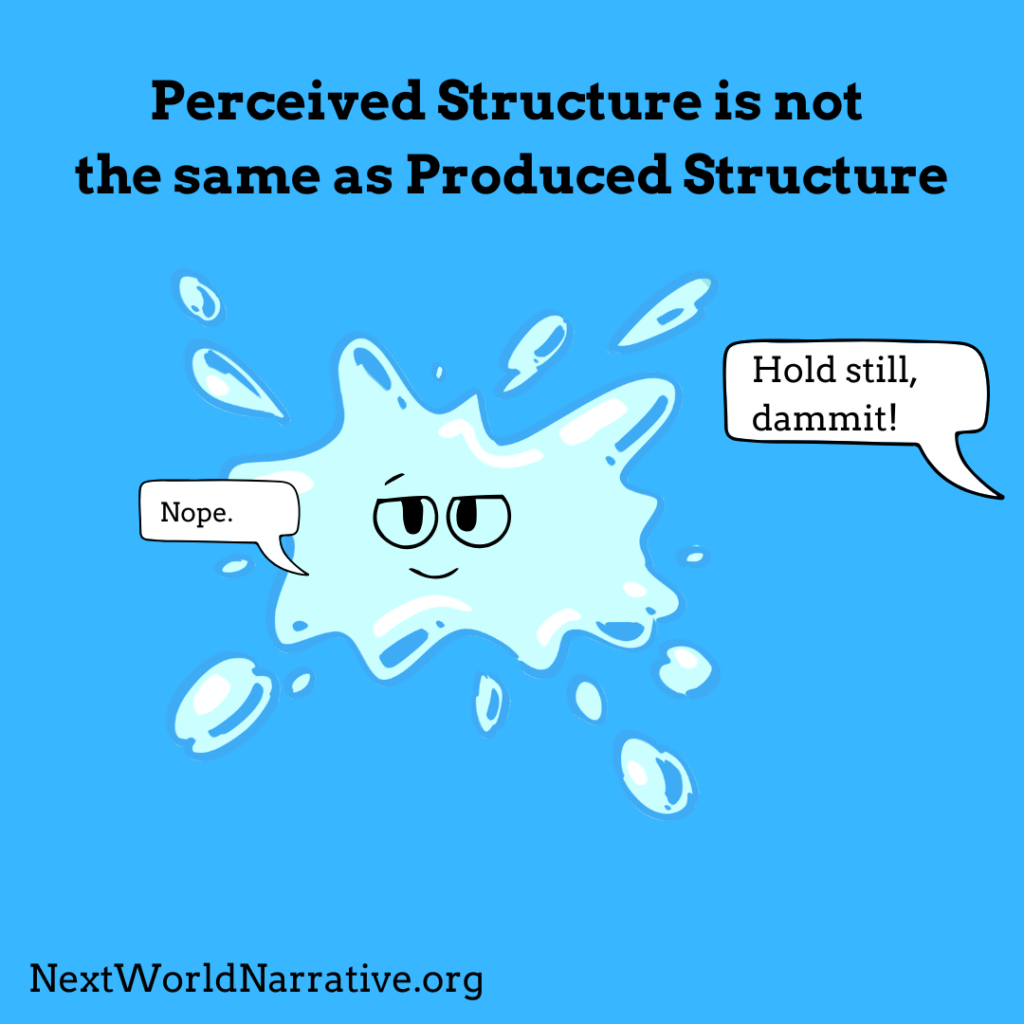
I call the two different approaches perceived and produced design. [Edit: Argh, ‘produced’ may be a poor word choice considering the prevalence of producers using perceived design. Tell me your thoughts!] Both can be used. But given the prevalence of perceived structure, we need to give voice to the latter. We need to stop conflating them. Stop upholding the idea the outsider is the only position and the only insight of value. We need to also know the value of subjectivity, context, first-hand, and lived experience. We need to stop pretending that perceived design is the same as produced design. Equality is oppressive when differences are denied. Equality is liberating when all belong.
| Perceived Structural Design | Produced Structural Design |
| Projected The reader’s experience of a structure defines what it is. Example Skill: Identify character archetypes Example Skill: Identify existing “master” structures Example Skill: Identify sequence lengths | Subjective Structure is the result of hundreds of micro decisions informed by the creatives’ experiences, associations, views, and needs. Example Skill: Generate ideas by drawing on your pain and what you love Example Skill: Troubleshoot repair of an unforeseen design issue |
| Prescribed Structure is determined by others. Example Skill: Understand and apply existing structure(s) Example Skill: Design pacing of structural stages according to common sequence lengths | Chosen You can select your structure from a wide range of dramatic and real life options, or not use one at all. Example Skill: Map genre and structure Example Skill: Map meaning and structure |
| Pre-Made You don’t make a structure, you use an existing stencil. Example Skill: Apply existing structure | Customised or Generated Structure is malleable and can be designed Example Skill: Adapt existing structures according to your values and experiences Example Skill: Generate a structure based on your body’s rhythms and quirks |
| Persistent The end structure is the same as the beginning structure. It stays the same throughout the entire development process. Example Skill: Fit your ideas to an existing structure Example Skill: Continually audit and conform your work to the structure | Polymorphic Structure changes during development. Example Skill: Experiment with a starter structure Example Skill: Develop methods in mixing structures Example Skill: Design according to local (character, scene, player) needs and notice what emerges |
| All-Purpose Everyone uses the same structure because differences between people and projects are negligible. Example Skill: Removal of all personal elements that conflict with orthodox design | Protean Structures differ according to the people making and experiencing the work. Example Skill: Make any existing structure recognisably your own |
During the Q&A at the screenwriting conference last year, I laughed when I mentioned a benefit of perceived structure. Sometimes people project a traditional structure onto our wild work. Those who try to uphold design orthodoxy can inadvertedly approve of our liberated designs. Heh. Some can’t imagine a world beyond and project theirs everywhere. We’ll make our worlds anyway. We don’t need them to know it exists for us to make it. A liberated designer knows their worlds are real, too.
How to cite this page:
Dena, Christy (2026) “The Difference Between Perceived and Produced Structure” Next World Narrative, 17 September. Last updated 21 September, 2026. https://www.lovingchangestorytelling.org/articles/produced-design-is-a-bud-unfurled/
Library Updates: Originality, Anti-Racist Theatre & Underlying Models
Here are the latest additions to our Liberatory Craft Library! Craft tools, inspiration, & insights for building our next world, now. Some just remembered, some newly discovered.
📖 Books
👉 David Waddington’s The Hidden Curriculum of Videogames
https://www.mqup.ca/Books/T/The-Hidden-Curriculum-of-Video-Games
“Rather than asking whether games produce violent individuals, we might more productively ask how they contribute to a commitment to radical capitalism and a belief in highly individualistic worldviews.”
👉 Fawzi Mesmar’s Demystifying Game Development: On originality in game development
“It introduces the concept of creative sobriety—a practice that advocates better understanding our own sources of inspiration so that we can intellectually drive our creative voice closer to originality.”
👉 Mary Flanagan & Mikael Jakobsson’s Playing Oppression (and open access)
“A striking analysis of popular board games’ roots in imperialist reasoning—and why the future of play depends on reckoning with it.”
👉 Nicole M. Brewer’s The Anti-Racist Theatre: Crafting Theatrical Collaboration
“A how-to guide for theatermakers who want freedom from white supremacy in their creative practices.”
👉 Pamela Jaye Smith’s Beyond the Hero’s Journey: Other powerful mythic themes (2nd Edition)
“Having trouble making your story fit the pattern of The Hero’s Journey? Can’t quite make those paradigms match your own characters and plot? Maybe that’s because your story is actually based on a different pattern.”
📜 Articles
👉 Indi Young’s ‘What’s Wrong with Average‘
“Average solutions aren’t just average as in “meh.” They often cause harm to the people who weren’t considered in the design.”
👉 Sarah Fawn Montgomery’s ‘(Dis)Ableing the Creative Writing Workshop‘
“Though many writers experience the workshop’s desire for context, disabled writers have the added task of rewriting the very world their readers inhabit.”
👉 Shea Rigney & Tamika Worrell’s ‘A Missing Player: The absence of Indigenous games in schools‘
“Understanding how, and if, Indigenous developed video games are used in classrooms can aid in the identification of support for teachers and the benefits for students, particularly regarding colonial and decolonial discourse.”
📺 Audio Visual
👉 Eric Rosenfield/Literate Machine’s ‘How Will Capitalism End? The Orville, Eduard Bernstein, and What is to Be Done?‘
“What does comedic science fiction television show The Orville tell us about how capitalism will end?”
👉 Meguey Baker and Vincent Baker’s ‘Underlying Models‘
“Every game is based on some underlying models of our social reality. In this panel, we will discuss how to think about these models and how they will affect the games you create, with Apocalypse World as a working example.”
What I Do To Flourish Despite The Current “Straight-to-Execution” Culture
I love creating. I love it when people experience what I create. I love what they create. When folks around us have forgotten that they love of creation, too, it’s important we keep doing it.
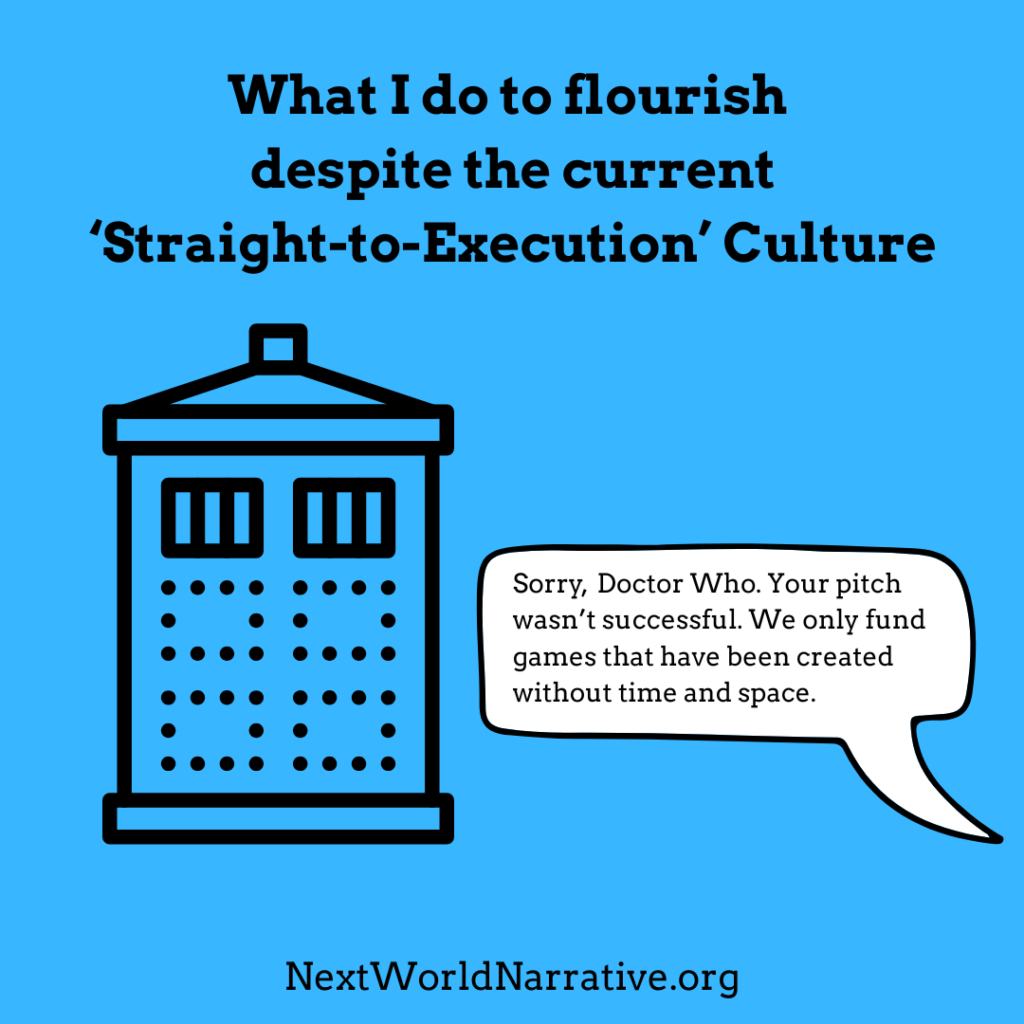
If you’re involved in pitching games, films, TV shows or even books, to publishers, studios, investors, broadcasters, and some funding bodies, then you’ll know how shitty it is right now. It’s been shitty for as long as design orthodoxy kicked in, but it’s pretty bad at the moment. The shitty topic for today is the straight-to-execution culture we currently find ourselves in. It’s when publishers and studios expect a script or book to be completely figured out so your pitch doesn’t change throughout production. It’s when funding bodies expect you to have the project fully figured out before you apply, or corrall you towards polish and financial partners quickly, or consider it too high risk if it isn’t already polished. It’s when publishers expect us to have a (digital) game fully produced, with polished visuals and interactions, and an inbuilt audience as well, before they’ll even consider partnering. Which makes their role kinda redundant and offloads the creative journey entirely. What this expectation results in is a) preference for folks who have no problem publishing first thoughts; and b) a lot of folks going straight to the final look. They invest all their time and resources on art, technical FX, big name casting, and building impressions, likes, and wishlists, and not making a game that works and resonants.
It’s Everywhere
Jane Korneyko of Sova explains the situation in the (tech) startup space: “This is the reality Australian founders are walking into. Not a market that rewards potential, but one that demands demonstrated operational maturity from day one. Investors are no longer funding stories. They are funding execution.”
Similarly, in film and TV, there is an expectation to stay with what you pitch. No development of ideas. You need to have already figured it all out and you’re not allowed to change it. TV writer-producer David E Kelley (LA Law, The Practice, Anatomy of a Scandal, Lincoln Lawyer, Goliath, Ally McBeal, etc) and Craig Mazin (Chernobyl, The Last of Us, Sheep Detective, etc) spoke about this:
“With The Practice, with Ally McBeal, with Boston Public, there was no script, no outline, and no real formal pitch. With Boston Public, I sat down with Sandy Grushow, who was running Fox at the time, and said, this is going to be a high school show. It’s going to be a public high school, but it’s going to be about the faculty. It’s going to explore the lives of the faculty and the adversities they face in trying to do their jobs every day.
We talked about the tone. It’ll be both dramatic and comedic. We talked about the kids will be instruments to explore these faculty members as well as the parents. There was an understanding that would be the DNA of the show, but we would then find the show in the writing. Today, it’s very different. When you’re going to pitch a show-
Craig: They want it all.
John: -the buyers are looking for such a specificity, and there’s a danger to that because you’re not letting the writers find and feel their way. If they’re living up to the notes or the outline that was a product of that goal of specificity, it can have a very creatively constraining effect.” — Scriptnotes
You’ll have your own examples of how this applies in your area (tell me about them!).
Why is this happening?
Part of the reason for this happening is, as Jason Della Roca explains, investors stopped trusting their instincts.
Before the pandemic, Della Rocca says, a studio could raise money on a strong prototype and a credible team, on how good an early build felt in the hands. What broke that was not a crash but a glut. The surge in players through lockdown pulled in a wave of investment, and when it receded it left an oversupply of games, and of the studios making them, all pitching at once. The people with money were suddenly seeing far more of everything and could still act on only the same few.
[…] Somewhere in that glut the people writing the cheques stopped trusting their own judgement. Too many bets had missed, playtime had softened after the lockdown highs, and in his words they “lost their confidence in their ability to pick winners.” A funder who no longer trusts it has an obvious way out, which is to let the market do the judging. […] So the burden of proof moved onto the developer. Studios began doing the work a publisher was once meant to do, announcing early, cutting trailers, gathering wishlists, working festivals, viral TikTok posts and Discord, building the evidence of demand before approaching the people with money. Della Rocca calls it “inception publishing,” the point at which a developer has to run the marketing to prove the game is worth marketing. — The Side Quest
That’s not all, though. As deliberate designers, we look to multiple contexts. Not just the first one.
Another reason is that, currently, most of the loudest people advising creatives, and those in decision-making positions, are not (design) creatives themselves. We have assessors, managers, producers, and even lawyers telling creatives how to design. Now, I want everyone to have a voice. What I don’t want is those who don’t make to have the power to dictate how we make. Indeed, no one should have power over how we make. We have the best knowledge of what we need. Advice is great, but every person ultimately needs to direct their creative process. Those who are more familiar with the result of a creative process don’t know how that output came to be. (I have an article about the difference between perceived and produced structure.) Therefore, they want something they recognise (an end-product) rather than something they don’t recognise (a work-in-progress).
Part of the reason, too, is the language used to talk about craft. I went over these issues in my workshops recently (and will share in a forthcoming book). There is a deep narrative that ‘thingifies‘ life and creativity. The cumulative effect of all those folks saying that design is a “rule,” “commandment,” a “natural law,” “it was already figured out yonks ago,” and “every single story does the same thing,” etc — renders design outside our hands. Design isn’t something you figure out, you make, it’s something you “discover.” That means all you have to do is read that book, listen to that guru, copy that “master” and apply it. Bing, bang, done. Design is a thing, not a process or a relationship. This is why many decision-makers and creatives don’t know how to assess quality. They don’t know how to assess process and effect.
Part of the reason, too, is that there are plenty of folks who aren’t in games, film, or TV for the joy of making. A great number of game companies in Australia have become service studios (bought up by Keywords). They don’t do original productions, only provide art, programming, design, etc for companies. There can be a beauty in that, but I see so many uninspired by the experience. I also speak with disenfranchised colleagues who work on big name projects. They talk about meetings where it’s all about making the products gorgeous-looking and juicy, and none of the leads give a shit about design. They get paid, praised, and even awards, anyway. So, why bother?
They’ve been taught through a million paper cuts that there is only one criteria: money. It’s a red herring, though. Are developers in big money studios always the best at what they do? No. Are projects that sell a lot always good design? No. Do projects with good design always sell? No. Are projects that sell always good for the world? No.
We can say the problem is “Capitalism.” That is one term. Another I like to use is what political philosopher Sheldon Wolin calls “inverted totalitarianism.” It’s capitalist, yes. It’s anti-working-class, yes. It’s individualist, yes. It’s not top-down, though. It’s upstream. What I, and Wolin, mean is that it isn’t overtly forced but it is taken on and upheld. Wolin explains that “inverted totalitarianism comes into being, not by design, but by inattention to the consequences of actions or especially of inactions. Or, more precisely, inattention to their cumulative consequences.” In this context, design is just a thing we do to make money for ourselves, that’s it. It doesn’t contribute to culture. It’s not a process we need to spend time on. In fact, we can outsource it. We can offload it. Bada bing, bada boom. (The use of GenAI to replace creative process is not a coincidence in this culture — more about this in another post.)
But design does have consequences. For instance, if we put effort into providing more basic universal services, then people who don’t give a shit about creative works wouldn’t bother with creative works. If their basic needs were taken care of, we’d see a lot of people who aren’t here for this kind of creativity, leave. That would be great. I hope they find what enlivens them.
This non-creative-driven, design-is-a-thing, inability-to-assess-quality, and disenchantment is not a great design culture. It corrupts the creative process.
It Corrupts the Creative Process
Devs don’t have much to fund their projects. Publishers and partners want a polished product before they’ll consider funds. This leads many devs to (understandably) skip the messy-looking stage. The problem is, when we go straight to producing beautiful visuals, polished interactions, it looks like the game is ready when it isn’t. The pretty conceals the problems we haven’t solved.
“Because high-fidelity visuals don’t actually create clarity. Rather, they hide the fact that the work wasn’t done, with detail that is every bit as fake as the sketch — but enough to satisfy stakeholders who are looking for an output.” — Pavel Simonson
Ironically, pre-defining the end result makes it less likely we’ll achieve it. The creative process involves lots of dead ends and experiments that are unlikely to work. It even means going in the opposite direction at times. All of this work accumulates like an upswell and lifts us to our destination. (See research into the myth of the objective.)
Professionals behave very differently than those unfamiliar with the creative process would expect. Professional skill doesn’t mean going straight to the end product. Nope. It means going straight to multiple possible products.
“The first time most people work with a pro designer, it’s a surprise how much time they spend exploring different possible ideas. It’s not uncommon for a designer who’s working on a watch, or a mobile app, or a toaster oven, to make dozens of sketches and prototypes, maybe even hundreds as they refine the details of how everything looks and works. Many people think, “well, if you’re good at design, you should just be able to design me something good the first time.” But to design something even as seemingly simple as a backpack, designers may spend hours exploring options and asking questions.”
“Not only is picking the first option you come up with not how good design works, it’s not how good decision-making works, either. Would you marry the first cute person you met? Or move to the first country you see in a movie? An analogy offered to me by designer Delaney Cunningham is to think about the last time you bought a new pair of shoes to match a specific outfit. Did you just walk into the store and grab the first pair you saw, without looking at the size, then buy them without even trying them on? Most people know that in order to find the right pair, they have to try many different designs, make observations and then refine their idea of what good is as they go. We also know that there is a tradeoff with shoes between the price, the style and the level of comfort they offer, and every pair is somewhere different in the combination of those three qualities. Buying shoes has a sequence of steps (ha ha) that you must go through to arrive at a good solution. Design works in much the same way. It’s a process for finding and evaluating ideas to get good results.” — Scott Berkun, How Design Makes the World
We miss getting past first thoughts, which are rarely the best. We don’t get to the essential insights that having the time to reflect on what we create affords. In their paper, Alan Dix and Layda Gongora talk about the various functions of “externalising” (how we as creatives put what we have in our head into the world). They explain that we can externalise to pass on already formed ideas (informational). I want this character to say this and then this character to say that. Done. This is what many non-creatives think execution is about. Just make it! But there is also how the process of getting it out of our head helps us understand it (formational). The need to form it helps form the idea. Ah, I see I need a transition between this scene and the last. Then there is using the materials to think about the creation (transformational). I can only use three colours here. Hmm, what colour represents that character? Then there is when the materials become the subject of our thoughts (transcendental). Oh, when players see that character they interpret it in a different way, and that means they do this. Do I want my story to be about that? You see, when we can’t iterate as much as we need to, then we end up just publishing our first thoughts.
We end up putting all our energy into design-for-appeal and not design-for-resonance. This is why there are marketing pushes for first weekend and first week sales. Because once they play or watch it, it won’t reach any further. We can possibly get folks in the door, but then they’ll leave pretty quickly, won’t come back, won’t recommend it to others, and so on.
I could go on. Share stuff you see, too. Either way, we’re in a culture where so many of the folks in decision-making positions want us to go straight to the end product without development.
What to do?
For me, I love creating innovative entertainment projects with an eye for positive social impact. I don’t try to be innovative. I just create in a way that makes sense to me. Which happens to be different. I don’t try to change people, either. I do know design is contextual, though, and I want to bring out folks’ best selves. This kind of design takes longer than, “I’ll use existing mechanics and common anti-social themes.” So, here are some of the ways I amplify insights without a proper development budget. Here are ways I do what I love and get to the end many want, despite their best efforts to stop me.
- Cave & commons
- I get the most out of ideation by leaning into our different ways of seeing the world. We ideate separately and then blend together. It’s the quickest way to get a wide range of really interesting ideas you can then have fun trying to merge. It stops the same people’s ideas dominating, and ensures everyone doesn’t go with the first thoughts shared.
- Regular playtesting
- Putting my work in front of people at all draft stages accelerates my insights. I draw on our shared cognitive worlds to create a new one. I’m testing all the time with my pitches to colleagues while chatting, as well as organised tests. For me, I find it super helpful to understand how players are experiencing the work, and they come up with unintended play I often want to include.
- Deliberate questions
- Design orthodoxy encourages a fix-it culture with no regard for different creations. Feedback often assumes there is something wrong if it’s not finished yet and any difference is to be stamped out. I’ve learnt to be really strategic with my questioning to get past biases and bring back the joy of creating together. (More about this soon, too.)
- Low-fi prototyping
- Digital design is expensive. I’m working on tabletop games as well as digital games and the contrast is astounding. In the tablestop scene, you can pitch a game without art. Why? The publishers know that the game needs to work and art is something they know how to do. I wish digital publishing worked this way. If our games were assessed on the experience they facilitated with players rather than the polish, we’d see so much more wonderful stuff released. Anyway. With this insight, I use low-fi prototypes with my digital games to front-load insights as much as possible. With the 3D multiplayer game I’m currently developing, I’ve used a slide-show prototype, a live RPG, a 2D digital version using stock images, and a boardgame version to test the whole system cheaply. I can actually change something that I don’t like and the design gets better! (I also will release both the digital and tabletop versions.)
- Polymorphic development
- Related to this, I deliberately create the same project in different artforms and platforms. This reveals gaps and provides new perspectives so quickly. For instance, for a previous card game, I created a chatbot version (pre-GenAI), Twine version, and live performance versions. These were all forms I could easily do myself. So, whatever artform you can easily do. Painting? Use that.
- Full-team exposure
- Get the whole team exposed to the playtests. I learnt this from Jarod Spool. It gets everyone on the same page quickly. I’ve had so much time wasted because I’ve had to use broken builds because team members don’t think it’s that much of an issue. Getting them to see the pain players go through fixes that in a second.They don’t need to be in the room lol. Just record and give the team time to check them out.
- Backcasting
- Use strategic reflections as you go. For me, a great way to get insights into what you need to address is to trick our brains using a ‘pre-mortem.’ You pretend the project is finished and didn’t work. You come up with reasons it didn’t work, and reasons it did. They’re golden insights.
- Automation
- Save time by automating repeated steps. Seth Coster’s talk on this was a great help to me. There are plenty of tools (including free ones) around to make it easier to get things done. For instance, a colleague, Ryan, put me onto how I get Google Drive being linked to my desktop. So, I don’t need to upload stuff to online folders. That gives me more time for design.
- Hire Relationships Not Skill
- There is a great talk by Mark Cerny where he covers his method to develop games. One of the things he talks about the is the need to have your best people at the beginning of the process if you’re doing something innovative. There are a couple of counterintuitive things I want to mention here. 1) Best can’t mean skill anymore, and 2) Mass layoffs doesn’t mean great talent is available. I don’t know what the scene is like worldwide, but I know in Australia it is pretty hard to find good folks to hire. Especially programmers. One reason is that the games scene is ageist. It pushes folks with experience out in preference for younger devs. People who have worked in games for 5 years call themselves, and are called, veterans. The common knowledge base continually pivots around what creativity and work looks like when you’re early-career. There are also a lot of people who have been laid-off from big studios. But a good portion of those folks only worked on a portion of the projects. Unlike an independent, they haven’t worked on the full pipeline. For instance, they don’t know how to set-up a project or release it. They only know the bit they were allowed to do. Jonathan Blow talks about this. Not having the knowledge and skills is fine. But this is where soft skills comes in. Yesterday, Trent Kusters gave a private talk to us creatives who got into the Play Now games market. One of the things he quickly mentioned was that “there is no room for brilliant jerks in games.” He said he’s learnt that it is better to hire for trust over skill. I think his advice is helpful. There are plenty of folks with skill who will corrupt the creative process. They’re not there for the journey. I would much rather hire someone I can trust than someone who has the skill. Skills can be taught (with consults, etc). And trust can be broken. But a person who will keep working on their skills, including their relationships, they help the creative process happen.
- Cultural Interventions
- There are also the interventions to not just create despite the culture but to also help the culture recede. For me, this includes awareness, not giving in to it, changing the way we walk about craft, improving the literacy around how creativity works and how to assess projects without an end-product, and more.
These are just some of the ways I let the winds in. I don’t make my first thoughts. I listen to what I create. I listen to my team. My players. The world. The process.
Straight-to-execution culture doesn’t like time. I used to hate time, too. But now I love it. I love the gift it brings. Change. I want a project that changes. I want a project that changes with every person, animal, and bug it touches. The world isn’t done.
How to cite this page:
Dena, Christy (2026) “What I Do To Flourish Despite the Current Straight-to-Execution Culture” Next World Narrative, 9 September. Last updated 28 September, 2026. https://www.lovingchangestorytelling.org/articles/flourish-despite-straight-to-execution-culture
Craft Language is an Offer You can Refuse and Change
I went to an improv session on the weekend. Jamie gave us an exercise where we offer our partner something to do together (for instance, “let’s go to a rock band concert”). If our partner said yes, we’d improvise being at a concert together. If our partner said no, we’d try another offer. Our task was to notice our partner’s response. How did they say yes or no? Did their eyes light up? Did they close down? I noticed that whenever they said ‘no,’ I loved it. Not that I preferred a no to a yes. A yes gives information about what they like and love. But a no lets me know what doesn’t bring them alive. A no also helps me get to know them.
I’ll share something about my brain with you. I automatically think about future trajectories based on present and past information. A new bit of information and the trajectories shift. I learnt to hide this way of thinking. If I mentioned how action X could lead to outcome Y, people would screw their face up. It seems some folks have no conception of how a mind could do that. They assumed I must be acting according to their world logic: I must be making big, false, claims about something I couldn’t possibly know. I must be paranoid. I must think I could do magic. I knew the steps along the trajectory, so their views didn’t change my mind about the insight. They did, however, for a time, contribute to me not sharing my thoughts. I may have done this to avoid disdain. I know I did this because I had no idea how to explain that my world is different to theirs. It’s not magic or some superpower. It’s as regular as my cup of tea, and lots of people drink tea.
Time isn’t one-way, either. I looked back to the past for explanations of the present. I remember when I was a teenager. One day, mid-afternoon, I suddenly felt despondent and self-loathing (more so than usual lol). I knew I didn’t feel that way when I woke up, so I traced my steps through the day. I realised that the negative thoughts and feelings emerged after reading Dolly Magazine (it was different then). I stopped reading those teen magazines. I had a little less prodding me feel unnecessarily down about myself.
When I was teaching interactive storytelling, game design, screenwriting, whatever subject it was, I noticed how students responded. I learnt what happens when I teach this way and that way. If I change the game design props from a chess board to plants, the nature of the games they make are considerably different. Then, later in the course, the kinds of games they pitched changed, and so on. I made new offers, learnt new paths, and gradually built new trajectories. I thought about the offers they got from teachers in other courses, and from fellow workers after university. Peers who will be hellbent on saying bullshit like money is the only reality, professionals must ghost people, and so on. I thought, what I can offer now that might stay with them in the future. I don’t define their future. But knowing what is highly likely to be coming, I can give them a different present. A present that lets them know they don’t have to go with what they’re offered. A present that encourages them to know what brings them alive and closes them down.
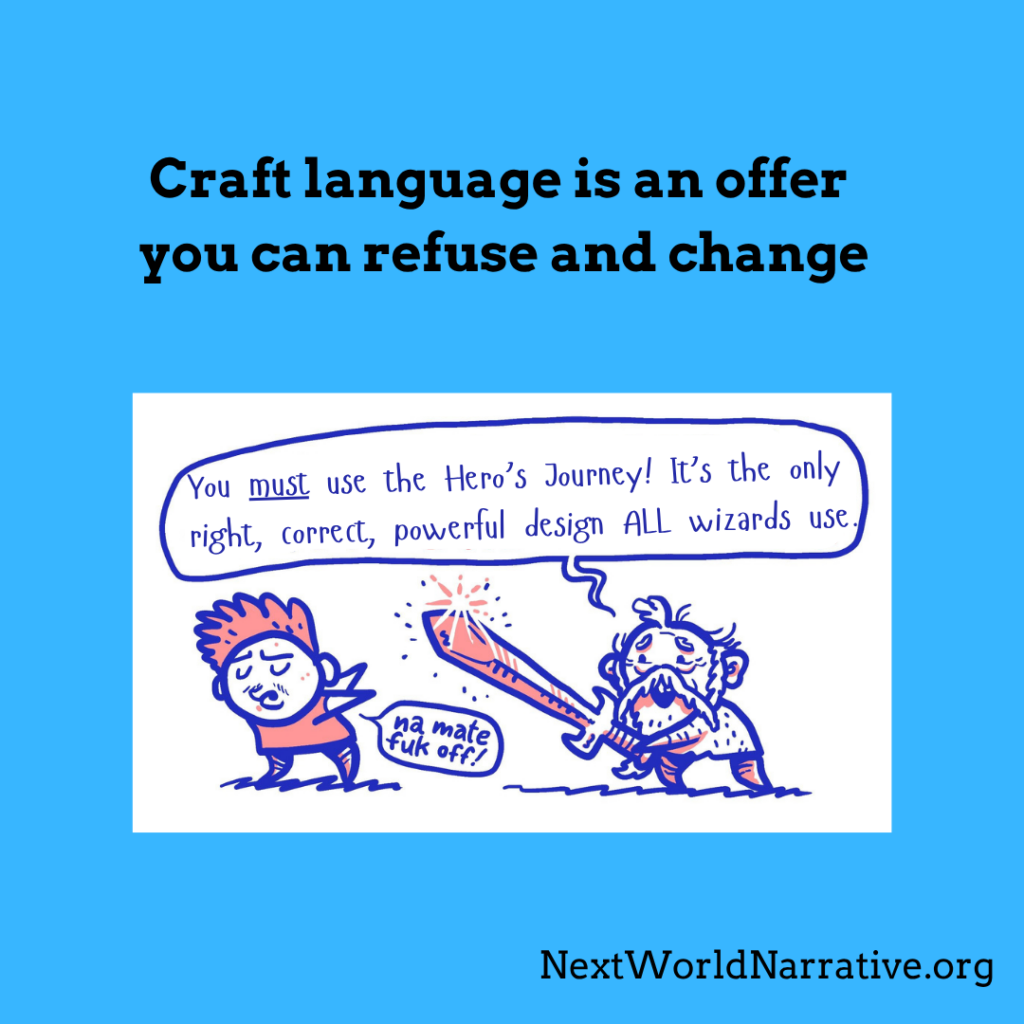
We don’t have to say yes to craft methods that don’t bring us alive. We can say no to their premise that design is fixed and we have no say in it. We can say no to their claims about the urgency of it all, and how their designs are the only way to be professional. In Strike!, documentary maker, historian and activist Jeremy Brecher details the history of (American) worker strikes. ‘If they refuse to work,’ he explains, ‘withdraw their cooperation, or take control of their own activity, “they have the power to reshape society.”’ Refusal says we don’t want this anymore and it gives space for what we do want. In Mohawk Interruptus, political anthropologist Audra Simpson details how the “people of Kahnawake” ‘had refused the authority of the state at almost every turn.’ Simpson calls it a ‘generative refusal.’ We can generate the world we want.
Recently, I ran public workshops on how we talk about craft. They were about the words we use when talking about screenwriting, game design, literature, development, peers, audiences, and so on. For instance, how continually using words like “commandment,” “physics,” and “natural law” to describe design can diminish a creative’s sense of agency. Calling different creative approaches a “sin,” “deviant,” or “unprofessional” not just delegitimises legitimate ways of creating, but also diverts many creatives away from their only way of flourishing. Sticks and stones can break my bones, but words can make me think I deserve it.
I ran the sessions because I noticed how alive I felt when I realised the words most story gurus use were closing me off what to really helps me, and that I could say no to them. At first, I noticed a pattern across many storytelling and game design manuals. I thought that the repetition of the same methods was a sign (as the authors claim) that they’re covering the good, great, true way to design. But the methods didn’t revolutionise my practice. No, it was when I noticed another pattern across the manuals that my practice evolved. They all use the same persuasive tactics to make me think they have the truth. Once I realised their tactics, the methods weren’t obligatory anymore. I didn’t have to go with their offers on how the world, creativity, and design works. I was free to find what suits me, and I did! I wanted others to know that, too. I put together preparation reading, and got to work.
It was a risk running the workshops because I wasn’t sure: 1) how many folks would be interested in the topic (or the way I framed it); 2) if folks would sign up even though it was direct to me and not through some big conference, festival, or institution; 3) if my costs would be covered as I deliberately made the workshops a choice of pay a relatively low fee, pay-what-you-want, or free. I ended up with colleagues from across three states in Australia, three states in the USA, UK, France, and Wales. I also had colleagues who couldn’t or wouldn’t make it, but wanted to chat via Zoom or email. Those interested included authors of screenwriting books, filmmakers, doco-makers, game designers, screenwriting university educators, researchers, and more. I knew them all, from my work across the last couple of decades and new colleagues. (So, I need to figure out how to communicate the insights to strangers, too.) My expenses were covered (but not my time). I loved learning what brought my colleagues alive and what they’re not interested in.
I shared the trajectories I see, backed up by my lived experience and research. I realised that there are very good reasons why some of the language used is appealing. I’m not talking about their persuasive strength. I’m talking about how their promises allude to positive things about the world. Promises they don’t deliver on. We can say yes to the promise and act on that, and no to the false practice they offer.
Outside of the workshops, I also noticed that a common response to the problem of Story Gurus giving bad advice is to police who gets to be a Story Guru. Undermining their power is helpful. What I think is also (even more) helpful is to know how it’s bad advice, and to promote a diversity of creative voices, not just a change of guard.
In the final workshop, I shared a tool to understand the relationship between the way we talk about craft, our everyday lives, and what is happening in the world. I have since then also figured out a way to systematise the ways to respond…using playfulness! Which is something one of the participants highlighted. Design orthodoxy language diminishes playfulness. But we know that creativity thrives in playfulness.
I noticed that the people who stayed to the end of all the workshops had shared qualities:
- Pain from being creatively and personally impacted by oppressive craft language
- Pain from actually, or concerned about, negatively impacting peers
- Yearning to have allies in their work and feeling emboldened to do something
- Yearning for a system to use in their own practice, teaching, & research
Based on that interest, I’m working on a short book version. I want it to bring the conversation about design back to how we can all flourish…how we can all feel alive when we create. I have a publisher who is interested and able to do this with a short turnaround. With that, I’d like to know what comes up for you. What are your ‘nos,’ ‘yeses,’ and ‘yes ands’ to anything I’ve said (and not said). This information helps me bridge my world with yours. Feel free to message me! Until then, yarrrrr, craft is an offer we can play with!
How to cite this page:
Dena, Christy (2026) “Craft is an Offer You Can Refuse and Change” Next World Narrative, 3 September. Last updated 21 September, 2026. www.lovingchangestorytelling.org/articles/craft-is-an-offer